



New World Development is reportedly considering a privatization and is in talks with Blackstone for up to $2.5 billion in financing.
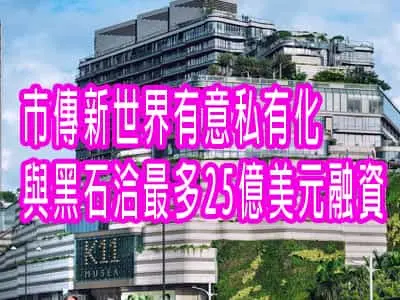
Table of contents
New World Development Company LimitedNew World Development (stock code: 00017, hereinafter referred to as "New World") is a well-known Hong Kong property developer founded by the Cheng family. Since its listing on the Hong Kong Stock Exchange in 1972, it has become a giant in the Hong Kong property industry. The company's business covers multiple sectors including residential, commercial properties, infrastructure, and services, and it owns iconic projects such as Victoria Harbour Cultural Centre and K11 Art Mall. In recent years, affected by the sluggish property market, debt pressure, and market volatility, New World's share price has continued to decline, and its market capitalization has shrunk from over HK$100 billion at its peak to approximately HK$18 billion in August 2025.
In August 2025, market rumors circulated that the Zheng family's...Chow Tai Fook Enterprises(New World's controlling shareholder, holding approximately 45% shares) is in talks with U.S. private equity firm Blackstone Group regarding a potential privatization. According to media reports, this potential deal aims to delist New World to allow for more flexible asset management.
Following the news, New World's share price surged by 201 TP3T on August 7th, closing up 10.191 TP3T at HK$7.14, with a trading volume of HK$1.062 billion. However, the company immediately issued a clarification announcement, emphasizing that no one (including the controlling shareholder and Blackstone Group) had contacted the company regarding a share acquisition offer. Although the rumors remain unconfirmed, this reflects the market's high level of attention regarding New World's privatization.
A senior real estate analyst pointed out that from the perspective of major shareholders, privatization can benefit their own people, as delisting eliminates the need to comply with the strict procedures for listed companies, such as shareholder voting and information disclosure, allowing for greater freedom in buying and selling assets. This is also the biggest incentive to initiate privatization. For the parent company, Chow Tai Fook Enterprises, privatization allows them to "dismantle" New World's assets to recover funds, but they will have to assume all debts, which may affect its credit rating. Tang Sing-hing, chairman of the Hong Kong Stock Analysts Association, believes that in a weak real estate market, the privatization price may not be ideal, posing a risk of "getting burned" for minority shareholders, but the company's debt crisis also poses a potential threat.
Changes in privatization
Privatization of a listed company refers to the process by which a controlling shareholder or consortium acquires the remaining shares, delisting the company from a stock exchange and transforming it into a private enterprise. This process typically involves a tender offer, shareholder voting, and regulatory approval. If New World goes private, it will transform from a publicly listed company into a family-controlled private company, bringing about numerous changes.
Firstly, regarding corporate governance, listed companies are required to comply with the Hong Kong Stock Exchange's Listing Rules, including regular disclosure of financial reports, shareholder approval for major transactions, and independent director oversight. After privatization, these requirements disappear, allowing major shareholders greater autonomy in decision-making. For example, asset sales no longer require public tenders or shareholder votes, accelerating business restructuring. This is advantageous to the Cheng family, as New World Development possesses abundant assets, such as the Victoria Harbour Cultural Centre in Hong Kong and mainland properties, allowing for more flexible restructuring.
Secondly, the changes in information disclosure are significant. Listed companies are required to disclose their financial results, price-sensitive information, and changes in director shareholdings quarterly or semi-annually. After privatization, information is limited to internal channels, and the public cannot access detailed financial data. This reduces market pressure but also decreases transparency, potentially affecting creditor confidence.
Third, the financing channels have changed. While listed companies can raise funds through rights issues, bond issuances, or warrants, privatization will likely lead to bank loans or private placements. Deng Shengxing points out that Chow Tai Fook has ample funds and can provide financing guarantees for New World Development at low interest rates and with a low leverage ratio. However, New World Development has a massive debt (net borrowings reached HK$129.1 billion in 2024), and privatization may exacerbate its financing difficulties.
Fourth, tax and legal changes. Privatization is subject to taxes such as stamp duty and must comply with the Companies Act and the Takeovers Code. If successful, shareholders may receive cash or share compensation, but minority shareholders who disagree can take legal action.
Finally, there are changes in employees and culture. Privatization can reduce administrative costs (such as audit fees), but may lead to layoffs or restructuring to improve efficiency. As a family business, privatization of New World could strengthen the Jung family's control and impact the corporate culture.
Overall, privatization allows companies to insulate themselves from market volatility, but at the cost of transparency. For New World Development, this may be a risk-averse strategy during a real estate downturn, but it requires balancing the interests of all parties involved.

Good and bad effects
Privatization has vastly different impacts on various stakeholders. The following analysis examines both the positive and negative aspects, focusing on major shareholders, minority shareholders, the company itself, and creditors.
Positive effects:
- For major shareholders (such as the Cheng family and Chow Tai Fook Enterprises)The biggest advantage is freedom of decision-making. After privatization, there are no longer the constraints of listed company rules, and assets can be bought and sold freely without shareholder approval or public disclosure. Analysts point out that this is a disguised form of "…".Benefit one's own peopleThis allows the family to manage its vast assets more effectively. Furthermore, it avoids the impact of stock price fluctuations on family wealth. With New World's stock price falling from approximately HK$30 in 2020 to HK$7 in 2025, the low valuation leads to low privatization costs, allowing the family to acquire the remaining shares at a low price.
- For the company itselfReduced compliance costs. Listed companies spend tens of millions annually on audits, disclosures, and investor relations. Privatization allows for a focus on core businesses, such as accelerating asset monetization to repay debt. New World possesses abundant assets (such as agricultural land reserves), and privatization can facilitate financing through Chow Tai Fook at low interest rates, improving the leverage ratio (approximately 72% in 2024). Tang Sing-hing believes this will help integrate with Chow Tai Fook, strengthening the overall company's capabilities.
- For minority shareholdersIf the offer price is reasonable, a premium can be obtained for exit. Rumors suggest that Blackstone's involvement could drive up the offer price to compensate for the recent share price slump. Minority shareholders can also avoid the risk of a corporate debt crisis, as seen in New World's total liabilities reaching HK$160.9 billion in 2024.
- To creditorsAfter privatization, the company may become more stable, and if Chow Tai Fook assumes the debt, its credit rating may be improved.
Negative impacts:
- For major shareholdersThe company would have to shoulder a massive debt. If Chow Tai Fook were to privatize New World Development, it would have to take on over HK$180 billion in debt, potentially impacting its credit rating and financing costs. A JPMorgan report indicated that Chow Tai Fook lacked the motivation to do so due to its heavy debt burden.
- For the company itselfIncreased financing difficulties. Private companies are unable to raise funds publicly and rely on bank loans. During a real estate downturn, assets are difficult to sell to repay debts, potentially exacerbating the liquidity crisis. New World's total assets decreased from 609 billion to 445.1 billion in 2023-2024, reflecting the pressure.
- For minority shareholdersIt's possible they'll "find a fool." Deng Shengxing estimates that in a poor market, the privatization price won't be good, forcing minority shareholders to exit at a low price. If they disagree, litigation costs will be high. After delisting, the shares will lose liquidity and become untradeable.
- To creditorsReduced transparency makes it difficult to monitor company finances. A credit rating downgrade increases the risk of debt restructuring.
In summary, privatization is more beneficial than harmful to major shareholders, but more harmful than beneficial to minority shareholders and creditors. This event reflects the weakness of Hong Kong's property market, necessitating extreme measures such as privatization, rather than refinancing.

Three different cases
The following are three privatization cases of Hong Kong-listed real estate companies, covering different periods and backgrounds, analyzing the process, changes, and positive and negative impacts. Each case includes a timeline.
Case 1: Privatization of New World Department Store (2016-2017)
New World Department Store China Limited (stock code: 00825) is a subsidiary of New World Development, specializing in department store retail. In 2016, New World Development proposed privatization, valuing the company at HK$7.8 per share, for a total consideration of approximately HK$6 billion. This is a typical case of a parent company acquiring a subsidiary.
Timeline:
- January 6, 2016: New World Development announced a privatization proposal at HK$7.8 per share.
- August 1, 2017: Postponed deadline.
- August 28, 2017: The suggestion expired due to insufficient support.
- Follow-up: Rumors resurfaced in 2025, but nothing came of it.
Changes: After delisting, the department store business was merged into New World Development, reducing redundant disclosures.
Positive impacts: For New World Development, it significantly reduced costs and consolidated retail assets. For minority shareholders, it allowed them to exit at a premium (the share price was around HK$5 at the time).
Negative consequences: Minority shareholders who disagree will miss out on opportunities. The company's debt burden will not lessen; instead, it will exacerbate the burden on the parent company.
Lesson learned: Privatization requires shareholder support and delays are common. New World can learn from this to avoid the risk of failure.
Case 2: Wheelock Privatization (2020)
Wheelock Properties Limited (stock code: 00020) is a long-established real estate company controlled by the Peter Woo family, which owns assets such as Wharf Holdings. In 2020, the family privatized the company through a combination of shares and cash, for a total consideration of HK$8.15 billion.
Timeline:
- February 27, 2020: Announced privatization, with shareholders receiving 1 share of Wharf Real Estate Investment Company + 1 share of Wharf Holdings + HK$12 in cash.
- June 16, 2020: Approved by the shareholders' meeting.
- July 28, 2020: Delisting, releasing shareholder value.
Changes: Elimination of the controlling stake discount; asset injection into Wharf Real Estate Investment Company and Wharf Holdings.
Positive impacts: For the family, decision-making becomes more flexible, unlocking value (market capitalization of HK$106.2 billion). For minority shareholders, they receive shares plus cash, with a high premium.
Negative impacts: Minority shareholders are required to hold new shares, affecting liquidity. Creditors are concerned about transparency.
Implications: Hybrid payment models are effective, and the New World could consider similar approaches to reduce cash pressure.
Case 3: Privatization of Joy City Property (2025)
Joy City Property Limited (stock code: 00207) is a commercial real estate company under COFCO Group. It announced its privatization in 2025, spending HK$2.9 billion to delist, with a premium of nearly 70%.
Timeline:
- July 31, 2025: Announced a share buyback through a scheme of arrangement and applied for delisting.
- August 2025: Expected to be reviewed at the shareholders' meeting.
- End of 2025: Delisting is expected to be completed.
Changes: COFCO Holdings integrates resources and deepens business integration.
Positive impacts: For the controlling shareholder, it leads to a unified brand and reduced management costs. For minority shareholders, it allows for a high-premium exit.
Negative impacts: After delisting, it will be difficult to liquidate assets, and debts may be transferred to the parent company.
Lessons learned: The successful privatization of state-owned enterprises demonstrates the valuable lessons that New World, as a family business, can learn from its integration strategies.
Timeline of New World Development (Table)
| years | Event Description |
|---|---|
| 1970 | Cheng Yu-tung founded New World Development. |
| 1972 | It is listed in Hong Kong, stock code 00017. |
| 2016-2017 | The proposal to privatize New World Department Store was rejected. |
| 2020 | Shares fell due to the pandemic, and debt rose to HK$113.7 billion. |
| 2023 | Total assets: 609 billion yuan; liabilities: 195.5 billion yuan. |
| 2024 | Assets fell to 445.1 billion, and net borrowing was 129.1 billion. |
| August 2025 | Rumors of privatization sent the share price soaring to HK$7.14. |

in conclusion
If New World's privatization goes through, it will bring profound changes, both positive and negative. Three cases show that privatization can optimize resources, but caution is needed regarding debt and shareholder equity. In the midst of a real estate downturn, this may become a trend, but regulatory balance is required.