


![[有片]拜祖先會獲得保佑?](https://findgirl.org/storage/2026/01/有片拜祖先會獲得保佑?-300x225.webp)


Female G-spot
Table of contents
Location, history, scientific research, causes and uses of the female G-spot
femalesPoint G(G-spotThe Gräfenberg spot, also known as the vaginal erogenous zone, is a controversial topic in human sexuality. It is described as a sensitive area inside the vagina that, when stimulated, can bring intense sexual pleasure and orgasm.
In the history of human exploration of sex and the body, the "G-spot" (Gräfenberg Spot) is undoubtedly one of the most controversial, mysterious, and intriguing topics. Since the German gynecologist Ernst Gräfenberg first proposed the concept in the early 20th century, the G-spot has not only become a focus of sexological research, but has also profoundly influenced public understanding of female orgasm, vaginal pleasure, and bodily autonomy.
However, to this day, the medical community still has great disagreement about the existence of the G-spot, its exact location, physiological structure, and function. Some consider it the "key to female sexual pleasure," while others believe it is merely a "collective fantasy" or part of the "clitoral extension tissue."

Location of point G
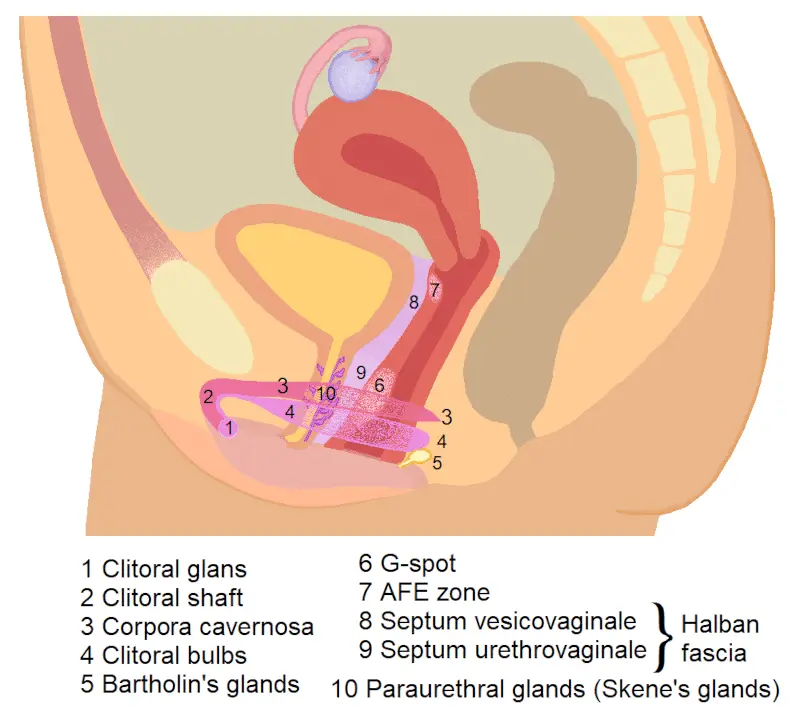
The G-spot is typically located on the upper anterior wall of the vagina, about 5 to 8 centimeters (50 to 80 millimeters) from the vaginal opening, between the vaginal opening and the urethra. Specifically, it's close to the pubic bone, approximately at the 11 o'clock to 1 o'clock position on the anterior vaginal wall, resembling the female prostate gland. This area may be difficult to notice when unstimulated, but it may swell and protrude to about 50 mm when subjected to pressure or friction. The location varies from person to person; some women may find it closer to the vaginal opening, while others find it deeper. It may also connect to the internal clitoral tissue and extend to the area around the urethra.
For example, during clinical examinations, physicians often use their fingers to palpate the anterior vaginal wall clockwise to locate the G-spot. Studies show that the G-spot may be located at one-third to one-half of the vaginal wall, measured from the vaginal opening. Another study indicates that the G-spot may be related to Skene's glands, which are located near the urethral opening and resemble the male prostate.
Historical Timeline
The concept of the G-spot is not a modern invention; its origins can be traced back to ancient medicine. The following timeline presents key historical events to illustrate the evolution of the concept:
| Time period | Event Description | Key figures or research |
|---|---|---|
| The Middle Ages (c. 12th-15th centuries) | Western medicine believes that the release of bodily fluids in women is beneficial to health, and doctors treat "uterine asphyxia" or hysteria by rubbing the vaginal walls. | No specific person is mentioned; it is based on ancient Greek medical traditions. |
| 17th century (1672) | Dutch physician Renier de Graaf described an erogenous zone inside the vagina, which he believed was homologous to the male prostate, and observed the secretion of lubricating fluid during intercourse. | Rainier Dekhlav. |
| 1940s | German obstetrician and gynecologist Ernst Gräfenberg, who studied the area around the urethra, pointed out that the area on the anterior vaginal wall close to the urethra is the erogenous zone. | Ernst Griffinberg. |
| 1981 | Addiego and others first used the term "G-spot" to refer to the area, a name derived from the initial "G" of Greifenberg's name. | Adigo and others. |
| 1982 | The publication of the book "G-Spot and Other New Discoveries in Human Sexuality" brought the concept of the G-Spot into popular culture. | Alice Kahn Ladas, Beverly Whipple, and others. |
| 1983 | Early clinical studies tested women’s responses to stimulation of the anterior vaginal wall. | No specific focus, but it lays the foundation for subsequent research. |
| 1990s | A survey on female ejaculation revealed that 40% women reported ejaculating during orgasm. | Milan Zaviacic and others. |
| 2000s (2005-2009) | MRI and ultrasound studies confirmed the association between the G-spot and clitoral tissue. | Helen O'Connell, Odile Buisson, and others. |
| 2010s (2011-2014) | fMRI studies support the independent existence of the G-spot; however, the review points out a lack of consistent evidence. | Research at Rutgers University and King's College London. |
| 2020s to present | A systematic review showed that 62.91% of women with TP3T reported having a G-spot, but scientific controversy continues. | Multiple meta-analyses. |
This timeline shows that the concept of the G-spot has evolved from medical treatment to sexological research, undergoing a process from subjective description to scientific verification.

Scientific research data and charts
Scientific research on the G-spot is largely based on clinical findings, self-reported surveys, and imaging, and the data shows discrepancies. The following table presents key research data, visualized as a bar chart or pie chart (e.g., percentages can be seen as pie chart distributions, and numbers as bar heights):
| Year and Source of Research | Sample size | Key data | Explanation (Chart Simulation) |
|---|---|---|---|
| 1983 clinical study | 11 women | Four individuals (36.4%) showed a specific response to stimulation of the anterior vaginal wall. | Pie chart: 36.41 TP3T shows a response, 63.61 TP3T shows no response; indicating that the G-spot is not universal. |
| 1990 survey (Milan Zaviacic) | 2,350 professional women | 40% reports ejaculation during orgasm; 82% reports ejaculation in women with G-spot. | Bar chart: Ejaculation rate 40% (overall), 82% (G-spot owner); emphasizing the correlation between G-spot and ejaculation. |
| The 2009 King's College London Twins Study | 1804 twin women | There is no objective evidence to support the existence of the G-spot, and subjective differences are significant. | Scatter plot: Low genetic correlation (<0.5), challenging the biological basis. |
| 2011 Rutgers University fMRI study | Multiple women | Stimulation of the G-spot activates the sensory areas of the brain differently than stimulation of the clitoris or cervix. | Thermographic simulation: The G-spot activation region is independent, supporting physiological differences. |
| Turkish Studies in 2018 | healthy female samples | 50% believes in the existence of the G-spot and its association with better sexual function. | Pie chart: 50% Believe, 50% Disbelieve; related scores are above average. |
| 2021 System Review (PMC) | Based on multiple studies (>1000 participants) | 62.91% of women with TP3T reported having a G-spot; the clinical recognition rate was 55.41%. | Bar chart: Self-reported TP3T 62.91, clinical TP3T 55.41; showing subjective > objective. |
These data demonstrate the heterogeneity of G-spot studies: high self-report rates (approximately 601 TP3T), but only about half supported by clinical evidence. Reasons include methodological differences (e.g., self-report vs. imaging) and individual variability. Charts are useful for visualizing trends; for example, bar charts can highlight the gap between self-reported and clinical findings, helping to understand the controversies.

Reasons for existence
The existence of the G-spot may originate from embryonic development and evolution. During the embryonic period, the male and female reproductive systems differentiate from the same structure: males develop a prostate gland, while females form Skene's glands, located around the urethra, functioning similarly to the prostate and possibly secreting fluid (female ejaculation). Research suggests that the G-spot may be an internal extension of the clitoris, with clitoral tissue surrounding the vaginal wall, causing swelling and pleasure upon stimulation. Evolutionarily, the G-spot may promote reproduction, enhancing sexual pleasure to encourage reproductive behavior. Another hypothesis is that it is a remnant of the female "prostate," whose secretory function has been documented since 1672. Scientific disagreement lies in the fact that some studies suggest the G-spot has no independent structure, but is merely a sensitive point within the clitourethral-vaginal complex; others view it as an independent erogenous zone due to its dense nerve and blood vessel network. In short, the reasons combine anatomy (clitoral homology), physiology (ejaculation function), and evolutionary adaptation.

What is its use (purpose)?
The primary purpose of the G-spot is to enhance sexual pleasure and the quality of orgasm. Stimulation of the G-spot can lead to intense arousal, vaginal orgasm, and even squirting (female ejaculation), which some women describe as "more profound" than clitoral orgasms. Practical applications include:
- Improved sex lifeStimulating the G-spot with fingers or toys, combined with clitoral stimulation, can lead to multiple orgasms. Specific positions (such as woman-on-top) can help with localization.
- Medical treatmentIt can help treat sexual dysfunction, such as orgasmic disorder. G-spot enlargement (collagen injection) can increase sensitivity, but it carries high risks (infection, dysfunction), and the American College of Obstetricians and Gynecologists warns that its effectiveness has not been proven.
- Education and ExplorationUnderstanding the G-spot can help women explore their bodies, boost their confidence, and improve their intimacy. Studies show that women who believe in the existence of the G-spot experience higher levels of sexual satisfaction.
- Toys and accessoriesThe G-spot massager features a curved end and a soft material to enhance stimulation.
Despite its wide range of uses, not all women have a clearly defined G-spot due to individual differences; forced exploration may cause stress. An open attitude and practical communication skills are recommended.

Practical Guide: How to Explore and Stimulate the G-Spot
Following the theory, here comes the practical part. Below are detailed steps and tips for individuals and couples.
- A Personal Guide for Explorers:
- Create a relaxing atmosphere: Tension is the biggest enemy of sexual pleasure. Make sure you have plenty of uninterrupted time and create an environment where you feel safe and comfortable.
- Sufficient sexual arousal: Before attempting to explore the G-spot, sufficient foreplay is essential! Arouse yourself fully through clitoral stimulation, kissing, and caressing. In a state of arousal, the pelvic cavity becomes congested with blood, the internal and external structures of the vagina expand and become more sensitive, and the G-spot area becomes more prominent.
- Correct gestures and positions:
- Clean your hands and trim your nails.
- Adopt a position that makes it easy for you to reach your genitals, such as lying on your back or squatting.
- Insert one or two fingers into the vagina.Palms up(This is key!) The fingers are bent in a "Come-hither" gesture.
- As you gently explore the anterior wall of the vagina, you will feel an area that feels different from the smooth surrounding vaginal walls; it may be...A texture that is wrinkled or slightly rough.When you press it, you may feel a slight urge to urinate (this is normal, as the urethra is located below it).
- Continuous and accurate G-spot stimulation:
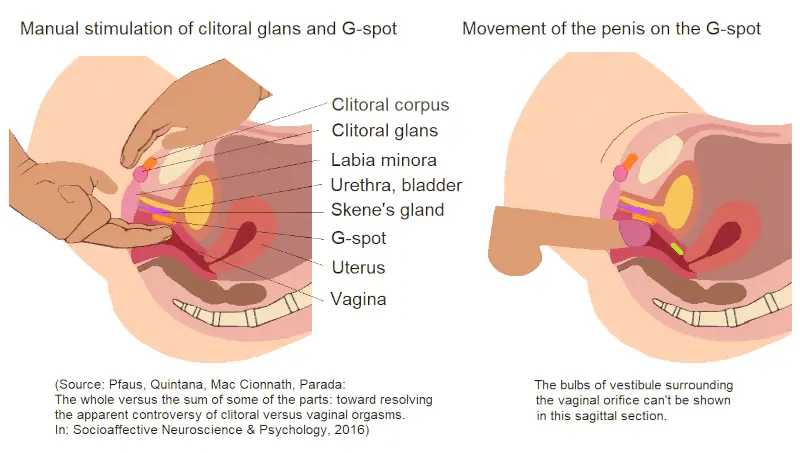
- This typically requires strong, deep, and sustained pressure, involving rhythmic pressing or "hooking" motions against the anterior vaginal wall. This can be achieved using fingers, tongue, or specially designed sex toys.
- Mixed stimulation: Simultaneous stimulation of the clitoris and G-spot greatly increases the chances of reaching orgasm and triggering squirting.
- Patience and communication: Don't expect to succeed on your first try. Treat it as an adventure with your body. Focus on all the sensations during the process, rather than just pursuing a so-called "orgasmic outcome."
- Collaboration skills for your partner:
- Communication is paramount: Communicate continuously with words or sounds before and during the process. "Is this the right spot?" "A little harder or lighter?" "How does this feel?"
- Optimal position: Certain sexual positions are more conducive to stimulating the G-spot because they allow the penis, fingers, or toys to contact the anterior vaginal wall at the correct angle.
- Doggy Style: The partner can adjust the angle to stimulate the anterior wall from behind.
- Girl on top(Woman on Top): Women can actively control the angle, depth, and rhythm to find the most stimulating position.
- Missionary position variations(Modified Missionary): Placing a pillow under the woman's pelvis to slightly elevate it, or bending her legs upwards and towards her chest, can change the angle of penetration.
- Using toys: Specially designedG-spot massagerorCurved vibratorIt will be very helpful. Their curved heads can apply pressure and vibration to the area more precisely.
- Important Notes:
- Feeling of need to urinate: This is very common because it irritates the bladder and urethra. Try to relax, and if the urge to urinate persists, empty your bladder first before continuing; this can alleviate psychological concerns.
- Not required: G-spot orgasms are not the "ultimate goal" or "required course" of sex. Many women do not experience G-spot orgasms and still have very satisfying and pleasurable sex lives.Never regard this as a test of sexual ability..
- Focus on pleasure itself: The purpose of exploration is to increase enjoyment, not create anxiety. If you don't feel anything special after trying it, that's perfectly fine; just focus on the things you already know that bring you joy.
Beyond the G-Spot: A Holistic View of Sexual Pleasure
Modern sexology is gradually shifting from searching for a single "magic button" to a more comprehensive and holistic view of sexual pleasure.
- The clitoris is the key: Science has confirmed that the clitoris is the core of female sexual pleasure, possessing over 8,000 nerve endings, with the sole function of providing pleasure. Whether directly stimulating the clitoral glans or indirectly stimulating the clitoral complex through stimulation of the G-spot, cervix, or other areas, the physiological basis is inseparable from this amazing organ.
- The brain is the most important sex organ: Desire, excitement, and orgasm are all greatly influenced by psychological factors. Feeling safe, being desired, emotionally connected with a partner, and not exhibiting anxiety are often more important than mere physical stimulation.
- Explore other erogenous zones: A woman's body is full of potential erogenous zones, such as the cervix, the A-spot (deeper into the anterior vaginal wall), and the U-spot (the area below the urethral opening). Readers are encouraged to explore the entire map of their body with an open mind, rather than focusing on just one point.
The G-spot, a focal point of sexology, is located 5-8 cm from the anterior vaginal wall. Its history dates back to the Middle Ages, and data shows that approximately 601 women (TP3T) self-report its presence. Its origins are rooted in anatomy and evolution, and its purpose is to enhance sexual experience. Despite ongoing controversy, scientific research continues to advance our understanding.

Further reading: