




What is proton therapy good for? Why is it so expensive?
Table of contents
What is a proton therapy machine?
Proton therapy machine(Proton Therapy Machine) is a type of machine that utilizes...Proton beamProton Beam is an advanced medical device for radiotherapy. It belongs to the category of particle therapy, which precisely targets and destroys tumor cells by accelerating protons to a high-energy state, while maximizing the protection of surrounding healthy tissue.

A simplified diagram of the proton-quark structure. The color of each individual quark can be set arbitrarily, but three different colors must be used and mixed to form white.
The "proton therapy machine" is not a single machine, but an extremely complex, large-scale, and sophisticated system. It combines cutting-edge technologies from physics, engineering, computer science, and medicine, with its core objective being to use high-energy proton beams to precisely destroy cancer cells while maximizing the protection of surrounding healthy tissue.
To understand proton therapy machines, we must start with the most basic unit—"proton"Let's start talking."
Note: In mainland China, this is called particle beam therapy.
![[有片]質子治療有什麼用?為什麼這麼貴?](https://findgirl.org/storage/2025/08/109.webp)
From Atoms to Protons: Fundamental Physics Concepts
Everything in the world is made up of atoms. At the center of the atom is a...Proton andNeutron CompositionAtomic nucleusThe outer perimeter hasElectron Surrounded. A proton carries a positive charge of one unit and has a mass approximately 1836 times that of an electron, making it one of the main sources of mass in matter.
In medical applications, we strip the electron from a hydrogen atom (the simplest atom, containing only one proton and one electron) to obtain positively charged protons. These protons, after being accelerated through a complex system and given extremely high energy, become a powerful weapon against cancer.
Bragg Peak: The Physics Core of Proton Therapy
The most fundamental difference between proton therapy and traditional photon (X-ray) radiation therapy lies in the way energy is released. This difference can be explained by a key phenomenon:Prague Peak(Bragg Peak).
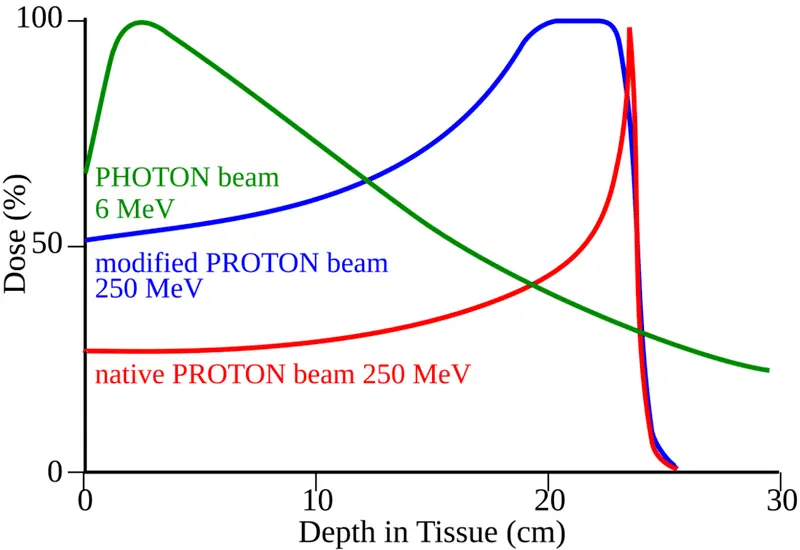
Energy release distribution diagram of single-dose photons (green), adjusted proton beams (blue), and pure proton beams (red) in tissues
- Traditional photon radiation therapy (X-ray or gamma ray):
When a photon beam enters the human body, its energy gradually decreases as it penetrates deeper into the tissue (exponential decay). The highest dose is usually distributed 1-2 centimeters below the skin. This means that in order for a sufficient dose to reach a deep tumor, healthy tissue along the path (entry point) and tissue behind the tumor (exit point) will receive a considerable dose, causing unnecessary damage and side effects. - Proton therapy (proton beam):
Proton beams exhibit entirely different characteristics. Charged proton particles, as they pass through tissue, collide with electrons in atoms along the way, gradually losing energy. However, this energy loss process is not linear. During the course of the beam…Initially, energy loss is minimal, and the dosage remains at a relatively low plateau..
When the speed of protons slows down to a certain extent, the probability of them interacting with matter increases dramatically.Within a very narrow depth range, the vast majority of energy is released instantaneously.This creates a dose peak that rises sharply and then falls abruptly; this is known as the "Bragg peak." The depth of the peak can be precisely controlled by adjusting the initial energy of the protons, ensuring that it falls precisely at the location of the tumor.
After the peak, the dose drops to zero almost instantaneously, meaningThe tissue behind the tumor receives almost no radiation dose..
Bragg Peak:
The proton releases maximum energy at the end of its range, after which the dose drops sharply to zero, and there is no "outgoing dose".
![[有片]質子治療有什麼用?為什麼這麼貴?](https://findgirl.org/storage/2025/08/31-8-2025-20-43-25.webp)
Chart Explanation:
- Traditional high-energy X-ray (photon beam) curve (red dashed line):
- characteristicThe dosage is highest near the skin surface and gradually decreases with depth after entering the body.
- shortcomingHealthy tissue behind the tumor receives a considerable amount of "outgoing dose" of radiation, while tissue in front of the tumor receives a higher dose than the tumor itself.
- Single-energy proton beam curve (blue solid line) – Bragg Peak:
- characteristicThe proton beam releases a small amount of energy in the early stages of entering the human body, and releases almost all of its energy instantaneously when it reaches a certain depth (i.e., the end of its range), forming a sharp dose peak (Bragg peak), after which the dose drops sharply to almost zero.
- advantage:Almost no ejection doseThe tissue behind the tumor is well protected.
- challengeA single peak is only suitable for very small tumors.
- SOBP proton beam curve (solid green line) – Extended Bragg peak:
- technologyBy adjusting the proton energy and superimposing multiple Bragg peaks of different depths, a broad, uniform high-dose platform is formed, which is sufficient to completely cover the entire tumor volume.
- Clinical applicationThis is the technique used in actual treatment. As shown in the image, it can precisely concentrate high doses in the tumor area (green shaded area) while significantly reducing the area in front of the tumor and...Especially the rearThe dose received by healthy tissues.
![[有片]質子治療有什麼用?為什麼這麼貴?](https://findgirl.org/storage/2025/08/lead_image.webp)
What is a proton?
A proton is a fundamental particle in the atomic nucleus, carrying a positive charge of one unit (+1e), equal in magnitude but opposite in polarity to the negative charge of an electron. The mass of a proton is approximately 1.6726 × 10⁻²⁷ kg, 1836 times the mass of an electron. In the atomic nucleus, protons and neutrons together form nucleons, tightly bound together by the strong nuclear force.
Structure and properties:
- Quark ModelAccording to the Standard Model of particle physics, a proton is a composite particle composed of three quarks: two up quarks and one down quark, bound together by the strong interaction force transmitted through gluons.
- stabilityThe proton is a stable particle, and proton decay has not been observed in experiments so far. This may be related to the predictions of the Grand Unified Theory, but further verification is still needed.
- Electromagnetic propertiesProtons are positively charged, so they are subjected to forces in electric and magnetic fields. This property has been applied in many scientific and technological fields, such as proton beam therapy and particle accelerators.
Historical discoveries:
- In 1917, Ernest Rutherford experimentally confirmed the existence of the proton for the first time. He used alpha particles to bombard the nitrogen nucleus and observed the release of hydrogen nuclei (i.e., protons), thus confirming the proton as a fundamental component of the atomic nucleus.
- After the 1950s, with the proposal of the quark model, the internal structure of the proton was gradually revealed.
Clinical applicationA single Bragg peak is very sharp and can only cover a small area of the tumor. Therefore, in actual treatment, technicians will stack proton beams of different energies to form an extended Bragg peak (SOBP), which can completely cover the entire tumor volume, while still maintaining the huge advantage of "low inlet dose and near-zero outlet dose".
![[有片]質子治療有什麼用?為什麼這麼貴?](https://findgirl.org/storage/2025/08/1012.webp)
Why are protons so important?
The proton's importance stems from its unique physical properties and wide range of potential applications:
Medical Revolution:
- Proton therapy offers cancer patients a highly precise treatment option with low side effects, and is particularly effective for children and tumors in sensitive organs. Clinical data shows that proton therapy can reduce damage to surrounding tissues by more than 301 TP3T.
Cosmology and the Basis of Life:
- Protons are the main component of baryonic matter in the universe. Visible matter above 901 TP3T in the universe is composed of protons. They are the fuel for nuclear fusion in stars (such as the Sun) and are also the basis of elements such as hydrogen, carbon, and nitrogen in living organisms.
- The acidity or alkalinity of water molecules (H₂O) and organic compounds are both related to proton migration (as defined by pH).
The driving force of science and technology:
- Proton research has spurred the development of major scientific and technological facilities such as particle accelerators and nuclear reactors, and has promoted the development of modern physics.
- In medicine, proton therapy represents the cutting edge of radiotherapy, providing cancer patients with a more effective option.
Key to Energy and the Environment:
- If nuclear fusion energy is commercialized, it will completely solve the human energy crisis, and protons are the core of this process.
- Proton exchange membrane fuel cell technology helps reduce greenhouse gas emissions and promotes the achievement of carbon neutrality goals.
![[有片]質子治療有什麼用?為什麼這麼貴?](https://findgirl.org/storage/2025/08/1011.webp)
Historical development
The concept of proton therapy is not new. Its development history is as follows:
Since the beginning of the 21st centuryWith the maturation of technology (especially the widespread adoption of pen-beam scanning technology) and a reassessment of cost-effectiveness, a global surge in the construction of proton therapy centers has emerged. As of 2023, more than 100 proton therapy centers were operational worldwide, primarily located in the United States, Japan, Europe, and China. Taiwan also currently has several medical centers equipped with proton therapy facilities.
1946:physicistRobert R. Wilson First, the potential of proton beams in medical applications was proposed, and the superior characteristics of the Bragg peak were highlighted.
1954The University of California, Lawrence Berkeley National Laboratory performed the world's first proton therapy to suppress pituitary function and treat metastatic breast cancer.
1960s-1980sTreatment mainly focuses onAccelerator in the physics laboratoryThe procedure is performed on the upper part of the eye, primarily targeting benign lesions near critical organs (such as arteriovenous malformations, pituitary tumors, etc.) and small-scale eye cancers (such as melanoma).
1990:USALoma Linda University Medical Center CompletedThe world's first hospital dedicatedThe establishment of the proton therapy center marks the official entry of proton therapy from the laboratory into clinical hospitals.
![[有片]質子治療有什麼用?為什麼這麼貴?](https://findgirl.org/storage/2025/08/a363a05f9e0eb316488829b87ab9040a.webp)
A significant milestone in the development of proton therapy
| Time period | Important milestones |
|---|---|
| 1946 | Robert Wilson first proposed the idea of using the Bragg peak characteristics of proton beams for radiotherapy in the journal Radiology. |
| 1954 | The University of California, Berkeley Radiation Laboratory (LBNL) conducted the world's first clinical application of proton therapy, irradiating the pituitary gland of a patient with advanced breast cancer. |
| 1961 | The Harvard Cyclotron Laboratory (HCL) began treating cases similar to those at Berkeley and became a major center for proton therapy research in the decades that followed. |
| 1970s | Japan (National Institute of Radiological Sciences, NIRS) and the Soviet Union (Dubna Joint Institute for Nuclear Research) successively began clinical research on proton therapy. |
| 1988 | The U.S. Food and Drug Administration (FDA) has approved proton therapy as a medical treatment. |
| 1990 | Loma Linda University Medical Center (LLUMC) in the United States has opened the world's first dedicated proton therapy center within a hospital, marking the transition of proton therapy from the laboratory to the hospital environment. |
| 2000s | Pencil beam scanningThe technology is mature and widely used, enabling intensity-modulated proton therapy, which greatly improves treatment precision. Indications have expanded to include prostate cancer, childhood tumors, and more. |
| 2010s to present | Compact proton therapy machineThe emergence of systems such as single-room systems has significantly reduced construction costs and space requirements. The number of proton therapy centers worldwide is growing rapidly, now exceeding 100. |
![[有片]質子治療有什麼用?為什麼這麼貴?](https://findgirl.org/storage/2025/08/639432fb8cf150e3d90309cdd054170c.webp)
Why is proton therapy needed?
The fundamental reason behind investing such massive resources in the development of proton therapy is that we hope to overcome the inherent limitations of traditional radiotherapy and pursue a higher therapeutic index, that is, to maximize the probability of tumor control (TCP) while minimizing the probability of normal tissue complication (NTCP).
![[有片]質子治療有什麼用?為什麼這麼貴?](https://findgirl.org/storage/2025/08/504.webp)
Challenges and limitations of traditional radiotherapy
Traditional photon radiotherapy (such as intensity-modulated radiotherapy (IMRT) and volumetric arc-modulated radiotherapy (VMAT)) is technically very advanced, but its physical characteristics dictate that it has some unavoidable drawbacks:
- High ingestion doseTo treat deep tumors, the skin and superficial tissues must be subjected to high doses, which may lead to dermatitis, pain, fibrosis, etc.
- Export dosePhotons can penetrate the human body, and healthy tissue behind the tumor will inevitably be irradiated. This is particularly problematic when treating areas filled with vital organs, such as the head and neck, chest cavity, and pelvis.
- High integrated doseBecause the dose is released along the way, the entire body receives...Total radiation doseThe integral dose is relatively high. Although the dose at a single point is not high, large-area low-dose irradiation may increase the risk of long-term secondary cancers, especially in children and young patients.
- Helpless against certain tumorsSome tumors are located close to critical organs that are extremely sensitive to radiation (such as the brainstem, optic nerve, spinal cord, and heart). Traditional radiotherapy cannot effectively avoid these tissues, resulting in the inability to deliver a radical dose to the tumor.
![[有片]質子治療有什麼用?為什麼這麼貴?](https://findgirl.org/storage/2025/08/1010-1.webp)
Appropriate treatment of diseases
![[有片]質子治療有什麼用?為什麼這麼貴?](https://findgirl.org/storage/2025/08/plate_1-1.webp)
Physical and biological advantages of proton therapy
The emergence of proton therapy was precisely to address the challenges mentioned above:
- Superior dose distribution (physical advantage):
Leveraging the characteristics of the Bragg peak, proton therapy can achieve "perfect conformation" (excellent conformation) to the shape of the tumor by placing the high-dose region, and thus:- Significantly reduce inlet doseNormal tissue along the path suffers less damage.
- Nearly zero exit doseThe tissue behind the tumor is almost perfectly protected.
- Significantly reduce total integrated doseIt can typically reduce the total radiation dose by 50-60 % compared to the most advanced photon radiotherapy.
- Permissible dose increase (clinical advantages):
Because the surrounding normal tissue is better protected, the doctorIt is possible to safely increase the radiation dose to the tumor.This is crucial for some tumors that are less sensitive to radiation. Higher doses mean higher tumor kill rates and local control rates. - Reduce short-term and long-term side effects (patient benefit):
Improved dose distribution directly translates to fewer side effects. Patients typically experience milder acute reactions during treatment (such as mucositis, skin reactions, nausea, and fatigue), resulting in a higher quality of life. More importantly, it significantly reduces some irreversible long-term sequelae, such as:- childIt has less impact on developing tissues and organs (such as the brain, bones, and glands) and cognitive function, significantly reducing the risk of growth retardation, endocrine disorders, and neurocognitive deficits. At the same time, it greatly reduces the risk of developing a second primary cancer induced by radiation.
- All patientsIt can protect vital organs, such as reducing the damage to the heart caused by radiotherapy for lung cancer, and reducing symptoms such as dry mouth, difficulty swallowing, and hearing loss caused by radiotherapy for head and neck cancer.
- Pioneering new areas of treatment:
For some tumors that were previously considered "radiation forbidden zones" or had poor treatment outcomes, proton therapy offers new treatment options. For example, liver cancer, centrally located lung cancer, eye cancer near the optic nerve, and paravertebral sarcomas can now be treated with proton therapy and have a better chance of being cured.
![[有片]質子治療有什麼用?為什麼這麼貴?](https://findgirl.org/storage/2025/08/5159ed2be9244a429b8c42699f3b3157tplv-xv4ileqgde-resize-h_1080.webp)
System composition of proton therapy machine
A complete proton therapy system mainly consists of the following core components:
- Ion Source:
This is the starting point of the entire system. It usually starts with hydrogen gas, which is ionized by means of an electric field or microwaves to produce positively charged hydrogen ions (i.e., protons). - Particle accelerator:
This is the heart of the system, responsible for accelerating protons to approximately 601 TP3T, the speed of light (requiring approximately 70-250 MeV). The vast majority of modern proton therapy centers use this system.Cyclotron orSynchrotron.- cyclotronIt has a relatively compact size and can generate a continuous and stable proton beam. Its advantages are stable operation and relatively simple maintenance.
- SynchrotronIt is usually larger in volume, accelerates protons in "clusters", and can more flexibly generate proton beams of different energies, but the system is more complex.
- Energy Selection System (ESS)(Mainly used in cyclotrons):
The protons produced by the cyclotron have a fixed energy. To treat tumors at different depths, an energy selection system composed of wedge-shaped materials is needed to reduce the proton energy, thereby precisely controlling the depth of the Bragg peak. - Beam Transport System:
This is a network of tubes in a high-vacuum environment, consisting of electromagnets (deflecting magnets and quadrupole magnets). It acts like a "highway," precisely guiding the proton beams from the accelerator to various treatment rooms. - Treatment Room and Beam Delivery System:
The proton beam is ultimately applied to the patient here. It mainly involves two techniques:- ScatteringThis technique uses a scattering foil to disperse a narrow proton beam, expanding it into a wider beam to cover the tumor. It is an earlier and simpler technique, but it produces more neutron contamination and offers slightly less protection to surrounding normal tissue compared to scanning methods.
- ScanningThis is the mainstream technology today, especiallyPencil Beam Scanning (PBS)The proton beam is kept in an extremely fine "pen tip" shape and directed onto the tumor target area by a precisely controlled magnetic field.Dot matrix layer-by-layer scanning(First move left and right, then up and down, and finally adjust the energy to change the depth). PBS technology can achieve this.Intensity-modulated proton therapy (IMPT)This means that it can not only control the distribution of the dose in three-dimensional space, but also deliver different doses to different areas within the same tumor. This is the most advanced and precise form of radiotherapy, and can be described as "sculpting" radiotherapy.
- Image-Guided Radiation Therapy (IGRT):
The treatment bed is equipped with a high-precision computed tomography (CT) or X-ray imaging system. Before each treatment, a real-time scan is performed and compared with the images in the treatment plan. The patient's position is then fine-tuned to ensure that the proton beam is precisely aimed at the tumor, with the error controlled within millimeters. This is the key guarantee for achieving precision treatment. - Treatment Planning System (TPS):
This is a powerful computer software system. Doctors and physicists input the patient's CT, MRI, and other imaging data to jointly delineate the extent of the tumor and the vital organs that need protection. The physicist then uses complex algorithms to calculate the optimal proton beam energy, angle, and scanning path to generate a highly personalized treatment plan. - Control and Safety Systems:
The entire facility is monitored by a central control room to ensure the accuracy of all parameters and is equipped with multiple safety interlock devices to guarantee the absolute safety of patients and staff.
![[有片]質子治療有什麼用?為什麼這麼貴?](https://findgirl.org/storage/2025/08/108.webp)
Why is proton therapy so expensive?
Proton therapy is extremely expensive (a single treatment costs several thousand US dollars, and a complete course of treatment can cost between $100,000 and $500,000), mainly for the following reasons:
- High equipment costs:
Proton therapy machines involve cutting-edge particle physics technology, and the manufacturing and installation costs of the accelerator, beam delivery system, and rotating gantry are extremely high (approximately $80-200 million per unit). In contrast, traditional radiotherapy equipment (such as linear accelerators) costs only $2-5 million. - Infrastructure and maintenance costs:
Proton therapy centers require specialized buildings (such as radiation shielding layers), and routine maintenance requires a team of professional physicists and engineers, with annual maintenance costs reaching millions of dollars. - Technology and human resource requirements:
Treatment planning requires a multidisciplinary team (radiation oncologists, medical physicists, dosimeters, etc.), and proton beam modulation technology is complex and training costs are high. - Research and development and certification costs:
The research and development of new technologies (such as pencil beam scanning) requires huge investments, and the strict medical regulatory approval processes in various countries further drive up costs. - Limited market size:
As of 2023, there were only about 100 proton therapy centers worldwide, which lacked economies of scale and could not spread costs.
Comparison of costs for various types of radiation therapy (using the United States as an example)
| Treatment type | Cost per treatment session (USD) | Cost of the complete treatment (USD) |
|---|---|---|
| Traditional photon radiation therapy | $500 – $1,000 | $10,000 – $30,000 |
| Proton therapy | $1,000 – $2,500 | $30,000 – $150,000 |
| Heavy ion therapy (carbon ions) | $1,500 – $3,000 | $50,000 – $200,000 |
Note:
- The cost difference is hugeActual costs vary greatly depending on the country, region, medical institution, type of tumor, length of treatment, and insurance policy. This table provides a general range.
- Complete treatment courseThis usually refers to a complete treatment cycle, which may last for several weeks and involve 20-40 treatments.
- Cost StructureThe cost includes not only the treatment itself, but also the costs of pre-treatment planning (such as CT simulation and dosage planning) and image navigation during treatment.
- Carbon ion therapyIt belongs to heavy ion therapy, which is more advanced than proton therapy. It has extremely high construction and operation costs, and there are even fewer centers worldwide, so the cost is usually the highest.
Proton therapy is primarily used for cancer treatment, and is particularly suitable for the following situations:
Local control of solid tumors:
- Central nervous system tumorsFor conditions such as gliomas, chordomas, and pituitary adenomas, proton beams can avoid damaging sensitive nerve tissues.
- Head and neck tumorsIt reduces damage to the salivary glands, optic nerve, and brainstem, and lowers the risk of xerostomia and vision loss.
- Childhood OncologyChildren's tissues are sensitive to radiation, and proton therapy can reduce long-term side effects such as growth retardation and secondary cancers.
- Prostate cancerPrecise irradiation of the prostate protects the rectum and bladder, reducing the risk of urinary incontinence and sexual dysfunction.
- eye tumor(e.g., choroidal melanoma): Proton beams can precisely target the back of the eyeball, avoiding eyeball removal.
Re-irradiation of recurrent tumors:
For patients who have relapsed after receiving conventional radiotherapy, proton therapy can retarget the tumor while avoiding damaged healthy tissue.
Tumors near critical organs:
For tumors such as those near the spine, liver cancer, and lung cancer, proton beams can avoid important structures such as the heart, lungs, and spinal cord.
Global distribution of proton therapy indications (2023 data)
| Indications | Percentage (%) |
|---|---|
| Prostate cancer | 25% |
| Head and neck tumors | 20% |
| Central nervous system tumors | 18% |
| Childhood Oncology | 15% |
| lung cancer | 10% |
| Other (such as liver cancer, etc.) | 12% |
![[有片]質子治療有什麼用?為什麼這麼貴?](https://findgirl.org/storage/2025/08/502.webp)
Are there any downsides?
Despite its unparalleled physical advantages, proton therapy is by no means a panacea. It has a number of significant drawbacks, limitations, and challenges. A clear understanding of its disadvantages is essential when considering proton therapy.
The economic cost is extremely high.
This is the most significant and direct drawback of proton therapy.
- Construction costsBuilding a proton therapy center is a massive undertaking. The cost of purchasing the equipment alone can reach tens or even hundreds of millions of US dollars. If you add in the costs of dedicated buildings, shielding, installation, and commissioning, the total investment can easily reach billions of New Taiwan Dollars. This is far beyond the reach of ordinary medical institutions.
- Operating and maintenance costsThe system consumes a huge amount of energy and requires a large professional team (medical physicists, engineers, technicians, and doctors) to maintain it. Its daily maintenance and parts replacement costs are extremely high.
- Treatment costsThe high costs will ultimately be passed on to the treatment expenses. The cost of a course of proton therapy is typically [amount missing] times that of traditional advanced photon radiotherapy (such as IMRT).2 to 3 times or even higherThis places a heavy burden on individual patients, the insurance system, and social healthcare resources.
This raises a profound question of medical ethics and economics: does such a huge investment bring additional clinical benefits that match the cost? This needs to be verified through more cost-effectiveness analysis studies.
![[有片]質子治療有什麼用?為什麼這麼貴?](https://findgirl.org/storage/2025/08/994.webp)
Technological complexity and uncertainty
- More sensitive to organ movement and setting errors:
The dose distribution of a proton beam is very steep, which is both an advantage and a disadvantage. If the tumor...breathe(such as lung cancer, liver cancer)Intestinal peristalsisorBladder fullnessDue to changes and displacement, the originally carefully calculated high-dose area may deviate from the tumor, while at the same time it may accidentally irradiate the healthy tissue next to it.
Therefore, proton therapy is effective forImage-based navigation (IGRT) andSports ManagementThe requirements for techniques such as respiratory gating and tracking are far higher than those for photon therapy. Any minute error could lead to treatment failure or serious side effects. - Range Uncertainty:
This presents a unique physical challenge in proton therapy. The calculation of the distance a proton travels within tissue (range) is based on an estimation of the tissue density converted from treatment planning CT scans into relative stopping power. However, this conversion is subject to error. Furthermore, the amount of protons in the patient's body during treatment...anatomical changes(For example, weight loss, tumor shrinkage or enlargement, tissue edema or atrophy) can all change tissue density, thus affecting the actual range of protons.
If the actual range of the protons is longer than planned, the Bragg peak will fall behind the expected range, damaging critical organs behind the tumor; if the range is shorter, the dose behind the tumor may be insufficient. Physicists must leave a safety margin for this uncertainty in the planning, which to some extent diminishes the precision advantage of proton therapy.
The size and accessibility of the equipment
- Large footprintA single cyclotron or synchrotron can weigh hundreds of tons, requiring enormous treatment rooms and shielded spaces. The sheer size of the entire center prevents its widespread adoption.
- Low accessibilityDue to cost and scale limitations, the number of proton therapy centers is limited, typically only a handful in a single country or region. This means that most patients need to travel long distances or even internationally for treatment, incurring additional time, financial costs, and physical and mental burdens.
The accumulation of clinical evidence still requires time.
While the physical advantages of proton therapy are undeniable, its ultimate...Clinical results(Effects such as long-term survival rate and the degree of improvement in quality of life) need to be confirmed through large-scale, long-term randomized controlled trials (RCTs).
- Lack of Level 1 evidenceCompared to photon radiotherapy, which has decades of accumulated experience, proton therapy still lacks the highest level of evidence-based medicine for certain types of cancer. Much of the data supporting its advantages comes from retrospective or single-arm studies.
- Ongoing researchCurrently, numerous clinical trials worldwide are comparing the effects of proton and photon therapy. While many results show that protons have a significant advantage in reducing side effects, the evidence for improving overall survival is not as conclusive as that for the physical advantage. This is also one of the reasons why insurance companies sometimes refuse to pay out.
Not applicable to all cancers
Proton therapy is not the best option for all types of cancer.
- Limited efficacy against widespread metastatic cancerFor advanced cancer that has metastasized to multiple sites throughout the body, treatment primarily involves systemic medications (chemotherapy, targeted therapy, immunotherapy), with local radiotherapy used only for palliative care. In such cases, the use of such expensive and complex proton therapy is unnecessary; conventional radiotherapy is sufficient.
- Concerns about certain highly invasive tumorsFor tumors with extremely indistinct borders and high invasiveness, the sharp dose fall-off property of proton beams may actually become a disadvantage, as it cannot guarantee coverage of all potential micro-lesions.
Neutron contamination problem (mainly related to scattering methods)
In AdoptionScattering technologyIn proton therapy, protons collide with devices such as scattering foils to produce...neutronNeutrons are uncharged particles with strong penetrating power, capable of causing low-dose radiation exposure throughout the body. Theoretically, this could slightly increase the risk of a patient developing a second primary cancer in the future. However:
- Tip Beam Scanning (PBS) technologyNeutron contamination has been significantly reduced because it eliminates the scattering foil.
- Even so, it remains to be analyzed whether the risks of PBS are higher or lower compared to the risks of secondary cancer associated with traditional radiotherapy, but it is generally believed that the risks of PBS technology are extremely low.
In summary, the "disadvantages" of proton therapy mainly lie in its staggering cost, extremely demanding technical requirements, and the still-accumulating clinical evidence. It is a powerful tool that requires careful use, and suitable patients must be rigorously selected by an experienced multidisciplinary team.
![[有片]質子治療有什麼用?為什麼這麼貴?](https://findgirl.org/storage/2025/08/ef3f1578a7f018025fcff0556c82cea1.webp)
Is there any benefit?
Despite the challenges mentioned above, the benefits of proton therapy are revolutionary, and in many specific clinical situations, its advantages far outweigh its disadvantages. These benefits are not only reflected in physical data but also translate into tangible improvements in patient survival rates and quality of life.
Unparalleled dosimetric advantages: the cornerstone of precision strikes
As mentioned earlier, the Bragg peak effect enables proton therapy to achieve dose distributions that are currently unattainable by any photon technology. This ability to "target precisely and stop immediately" is the root of all subsequent clinical benefits. It can perfectly envelop irregularly shaped tumors with a high-dose curve while reducing the dose to nearby critical organs to extremely low levels.
Significantly reduces side effects and improves quality of life
This is the benefit that patients can directly experience. Because the surrounding normal tissues are better protected, the toxicity of the treatment is significantly reduced.
- Head and neck cancer:
- Effectively protects salivary glands.Significantly reduce severe dry mouthThe incidence and severity of dry mouth. Dry mouth is not only uncomfortable, but can also lead to difficulty chewing and swallowing, speech impairment, malnutrition, and severe tooth decay. Proton therapy can significantly improve the long-term psychosomatic state of patients after treatment.
- It protects taste buds, hearing organs, and swallowing muscles, reducing the risk of taste loss, hearing loss, and difficulty swallowing.
- Cancers of the thoracic cavity (lung cancer, esophageal cancer, mediastinal tumors):
- Protect the heart and coronary arteriesReduces the long-term risk of radiation-induced heart disease (such as pericarditis, myocardial fibrosis, and coronary artery disease).
- Protect your lungsSignificantly reduces the volume and dose of radiation to healthy lung tissue.Significantly reduces radiation pneumonitisThe incidence and severity of [the disease]. This is crucial for patients with pre-existing poor lung function (such as lung cancer combined with COPD) to enable them to successfully complete radiotherapy.
- Protect the esophagusReduces the severe pain and difficulty swallowing caused by radiation esophagitis.
- Pelvic cancer (prostate cancer, rectal cancer, cervical cancer):
- Protect the bladder and rectumIt can reduce the occurrence of radiation cystitis and proctitis, and avoid problems such as hematuria, hematochezia, tenesmus, and incontinence.
- Nerves and blood vessels related to protective functionFor prostate cancer patients, it helps to better preserve sexual function.
- Systemic symptomsDue to the low total integrated dose, the patient experiences...Fatigue, nausea and other systemic reactionsThey are usually lighter as well.
![[有片]質子治療有什麼用?為什麼這麼貴?](https://findgirl.org/storage/2025/08/107-1.webp)
Improve tumor control rate and cure potential
- Dose escalation:
For some tumors where conventional radiotherapy cannot deliver sufficient radiation dose due to dose limitations imposed by surrounding organs, proton therapy offers the possibility of "dose boosting." For example:- Chordoma, chondrosarcomaThese types of tumors, resistant to conventional radiotherapy, are located at the base of the skull or beside the spine, close to the spinal cord and brainstem. Proton therapy allows for the safe delivery of higher doses, significantly improving local control rates and the chance of a cure.
- liver cancerProton therapy can deliver high-precision, high-dose irradiation to liver tumors (similar to surgical resection) while protecting sufficient healthy liver tissue, thus benefiting patients with poor liver function compensation.
- Locally advanced lung cancerHigher doses could be tried to overcome tumor resistance.
- Synergistic potential when used in combination with other treatments:
Proton therapy can be combined with chemotherapy, immunotherapy, and other treatments. Due to its lower side effects, patients are more likely to tolerate the combined therapy and will not need to interrupt or reduce chemotherapy due to excessive radiotherapy toxicity, potentially achieving a synergistic effect of "1+1>2". Especially when used in combination with immunotherapy, reducing unnecessary damage to immune cells (lymphocytes) may be more helpful in activating a systemic immune response.
![[有片]質子治療有什麼用?為什麼這麼貴?](https://findgirl.org/storage/2025/08/992.webp)
It holds an irreplaceable position in the treatment of childhood cancer.
- Developing tissues are extremely sensitive to radiation.Children's organs and tissues are in a period of rapid growth and development. Damage caused by radiation can lead to serious long-term sequelae, including developmental deformities, growth retardation, intellectual and cognitive impairment, and endocrine disorders (such as stunted growth and infertility).
- High risk of secondary cancerChildren have longer survival times and more active cell division, making them at a much higher risk of developing a second primary cancer induced by radiation than adults. Proton therapy, by significantly reducing the total integrated dose, can substantially reduce this risk, ensuring their health throughout their long lives.
- Typical applicationsFor intracranial tumors (such as medulloblastoma, ependymoma, low-grade glioma), head and neck sarcomas, neuroblastoma, etc., proton therapy has become a standard treatment option in the world's leading pediatric cancer centers, striving for the most normal possible future for children.
![[有片]質子治療有什麼用?為什麼這麼貴?](https://findgirl.org/storage/2025/08/寻找质子治疗机图片19.webp)
Treating previously difficult-to-treat tumors
For tumors located near the "no-go zone" for surgery and radiation, proton therapy offers new hope:
- Skull base tumorsIt is closely attached to the brainstem, optic chiasm, hippocampus, etc.
- Intraorbital tumorFor example, in cases of uveal melanoma, proton therapy can cure the tumor while preserving the eyeball.
- Paravertebral and intraspinal tumorsTreatment should be carried out while avoiding the risk of paralysis.
- Central lung cancerIt is closely attached to the trachea, major blood vessels, and heart.
Potential benefits of socioeconomic efficiency
Although the treatment itself is expensive, it may have socio-economic benefits in the long run.
- Reduce the cost of treating complicationsThe medical costs of managing severe radiation damage (such as heart disease or secondary cancer) after treatment are extremely high. Proton therapy reduces these long-term problems at their source, potentially lowering a patient's total lifetime medical expenses.
- Maintain productivityPatients experience milder side effects and are able to return to normal life and work more quickly, reducing the loss of social productivity.
![[有片]質子治療有什麼用?為什麼這麼貴?](https://findgirl.org/storage/2025/08/105-1.webp)
Proton therapy vs. conventional photon therapy: a comparison of key indicators
| Comparison indicators | Traditional photon therapy | Proton therapy |
|---|---|---|
| Dose distribution accuracy | Moderate (significant dose overflow) | High (with Bragg peak characteristics) |
| Volume of healthy tissue exposed to radiation | Larger | Reduce 30-60% |
| Long-term side effects risks in children | Higher | Significantly reduced |
| Single treatment time | 10-20 minutes | 15-30 minutes |
| Treatment costs | Relatively low | high |
Data source: The Particle Therapy Consortium (PTCOG), the American Society of Clinical Oncology (ASCO), and Nature Reviews Clinical Oncology.
NoteThe above information is based on the latest medical consensus in 2023. Specific treatment plans need to be evaluated by a professional medical team.
![[有片]質子治療有什麼用?為什麼這麼貴?](https://findgirl.org/storage/2025/08/104-1.webp)
Other applications
Protons have a wide range of applications, covering fields such as basic science, medicine, energy, and industry. The following are some of their main applications:
1. Basic scientific research:
- Particle PhysicsAs a fundamental particle, the proton is an important tool for studying the structure of matter and the origin of the universe. For example, the Large Hadron Collider (LHC) uses proton collisions to explore unknown phenomena such as the Higgs boson and dark matter.
- nuclear physicsProton beams are used to study the reaction mechanisms of atomic nuclei, such as nuclear fusion and nuclear fission.
2.Energy sector:
- Nuclear Fusion EnergyProtons are key participants in nuclear fusion reactions (such as hydrogen-hydrogen fusion). The International Thermonuclear Experimental Reactor (ITER) project uses proton-related reactions to simulate the mechanism of solar energy production.
- Proton exchange membrane fuel cell (PEMFC)Utilizing the principle of proton conduction, chemical energy is converted into electrical energy, which can be applied to green transportation and sustainable energy systems.
3. Industrial and Materials Science:
- Proton beam etchingIn semiconductor manufacturing, proton beams are used for precision etching and material modification.
- Neutron productionProton bombardment of a target can produce neutrons, which can be used for neutron scattering experiments or nuclear waste disposal.
![[有片]質子治療有什麼用?為什麼這麼貴?](https://findgirl.org/storage/2025/08/101-1.webp)
Future Development and Challenges
For most common cancers, traditional photon radiotherapy is a mature, effective, and cost-effective mainstream choice.
- However, for specific patient groups—Especially children, patients with tumors near critical organs, patients requiring further radiation therapy, or patients who may benefit from dose escalation—The benefits of proton therapy are enormous and irreplaceable.It can push the risk-benefit ratio of treatment to a new level, evolving from "curing the disease" to "curing the disease better," and while pursuing a cure, it can greatly preserve the patient's future quality of life.
In the future, with technological advancements (such as more compact and cheaper accelerator technology, FLASH ultra-high-speed irradiation technology, AI-assisted planning and image navigation), the continuous accumulation of clinical evidence, and the gradual optimization of costs, proton therapy is expected to benefit more patients and ultimately become one of the indispensable core pillars of precision cancer treatment.
Proton therapy represents the pinnacle of radiotherapy technology, offering cancer patients a better option due to its precision and safety. However, cost and accessibility remain major obstacles. In the future, with the development of compact machines and artificial intelligence technologies (such as superconducting accelerators and AI-driven treatment planning), costs are expected to gradually decrease, benefiting more patients. Simultaneously, clinical research needs to further expand the scope of indications and validate its long-term benefits through randomized controlled trials.
Further reading:


-copy-300x225.webp)
