


![[有片]拜祖先會獲得保佑?](https://findgirl.org/storage/2026/01/有片拜祖先會獲得保佑?-300x225.webp)


Limited Slip Differential (LSD) – An essential component for improving cornering performance

Table of contents
Limited-slip differentialLimited Slip Differential (LSD) is a feature used in automobiles.Transmission systemOne key technology allows for the alteration of the rotational speeds of the outer and inner drive wheels during cornering. This improves traction and stability under various road conditions, enhancing cornering performance.

When turning at a certain angle, the inner and outer rings trace different radii. Naturally, the outer ring must travel a longer distance and rotate faster than the inner ring. Otherwise (at the same speed), the inner ring would slip and consume too much rotation, making it unable to turn smoothly. In short, a differential is a mechanism that provides...Rotational differencesThe organization.
Traditional open differentials allow wheels to rotate at different speeds, but when one wheel slips, most of the power is transferred to that side, causing the other wheel to lose traction.Limited-slip differentialBy limiting this slip, power is distributed more evenly to both wheels, thereby improving vehicle handling and safety.

Limited-slip differentials are widely used inracingLimited-slip differentials are used in off-road vehicles and high-performance vehicles. Their development history dates back to the early 20th century, evolving alongside advancements in the automotive industry. This article will explore the historical milestones and timelines of limited-slip differentials, introducing both clutch-type and gear-type models. A timeline chart will be included to illustrate key development stages. The evolution of limited-slip differentials not only reflects engineering innovation but also drives progress in the automotive industry. Through in-depth analysis of their structure, working principles, advantages, disadvantages, and applications, we can understand how this technology has expanded from racing to everyday vehicles and continues to play a role in the era of electrification and intelligentization.
The basic principle of a limited-slip differential is based on friction and gear mechanisms. When a vehicle is traveling in a straight line, the wheels on both sides rotate at the same speed, and the differential operates like an open system. However, when encountering differences in speed on curves or slippery surfaces, the limited-slip mechanism intervenes, limiting the speed difference and redistributing torque. This not only improves traction but also reduces tire wear and energy waste. In modern vehicles, limited-slip differentials are often integrated with electronic control systems (such as…ABSandESCThis integration provides more precise power management. The discussion will begin with the historical context and proceed step by step.

Historical Development and Important Milestones
The concept of a limited-slip differential originates from improvements on traditional differentials. While differentials themselves can be traced back to ancient times, the modern limited-slip differential is a product of the 20th century. Below are its key historical periods and milestones, which we will detail from early foundations to modern innovations.

- Late 19th to early 20th century: Laying the foundation for differentials
The differential was first invented by the French engineer Onésiphore Pecqueur in 1827 for use in steam vehicles. In 1897, a British engineer...James StarleyThis technology was applied to bicycles and automobiles. This period laid the foundation for the basic principles of differentials, but the problem of slippage remained unsolved. Similar differential devices, such as the Antikythera mechanism, were recorded by the ancient Greeks as early as 100–70 BCE, but their actual application in automobiles did not occur until the late 19th century. These early designs were open-ended and unable to handle single-wheel slippage, leading to the need for further innovation.
- 1930s: The Birth of the Limited-Slip Differential
In 1932, an automotive engineerFerdinand PorschePorsche designed the concept of a limited-slip differential for Auto Union racing cars to improve their stability in corners. High-powered engines caused excessive rear wheel slippage at speeds up to 160 km/h, prompting Porsche to commission ZF Friedrichshafen AG to develop a solution. In 1935, ZF obtained a patent, marking the official birth of the limited-slip differential. Primarily used in racing at this time, it addressed the shortcomings of open differentials on wet surfaces. ZF's "sliding pin and cam" design was applied to Volkswagen military vehicles during World War II, such as the Kübelwagen and Schwimmwagen. Although strictly speaking a freewheel system, it laid the foundation for limited-slip differentials.
- 1950s: Commercialization and Popularization
In the 1950s, American automakers such as Packard and Studebaker began applying limited-slip differentials to production vehicles. In 1956, Packard introduced the Twin Traction system, an early example of commercialization. During this period, limited-slip differentials expanded from racing cars to civilian vehicles, particularly rear-wheel-drive models. In 1957, General Motors (GM) introduced the Positraction system for the Chevrolet, followed by Pontiac's Safe-T-Track, Oldsmobile's Anti-Spin, Ford's Traction-Lok, and Chrysler's Sure-Grip. These systems became popular during the muscle car era, and Positraction became a common term.
- 1960s-1970s: Diversification of Types and Technological Advancement
In the 1960s, disc limited-slip differentials (such as multi-plate clutch type) were widely used in muscle cars, such as the Chevrolet Corvette. In the 1970s, gear-type limited-slip differentials (such as the Torsen type) were developed by Gleasman, focusing on torque-sensing distribution. This period witnessed the initial integration of electronic controls, improving precision. In 1958, Vernon Gleasman patented the Torsen limited-slip differential, marking the practical application of gear-type differentials.
- 1980s-1990s: Electronics and High-Performance Applications
In the 1980s,Audi QuattroThe system incorporates full-time four-wheel drive, combined with a limited-slip differential. In the 1990s, electronic limited-slip differentials (Electronic LSDs) emerged, such as...BMWThe DSC system. During this period, limited-slip differentials became standard equipment on high-performance cars. In 1982, Torsen began marketing it for the Audi Quattro and...Subaru Impreza WRX STIIn 1996, AAM launched the TracRite series to improve traction.
- 2000s to Present: Modern Innovation and Electrification
In the 2000s, limited-slip differentials integrated ABS and ESC systems. In recent years, with the rise of electric vehicles, such as Tesla's dual-motor system, limited-slip functionality has been simulated. In the 2020s, hybrid vehicles further optimized limited-slip technology to accommodate regenerative braking. Electronically controlled models, such as the DCCD in the Subaru Impreza WRX STI, allow for driver adjustment.
| Time period | milestone event | Key contributors/applications | Type Development Focus |
|---|---|---|---|
| 1827-1897 | The basic invention of the differential | Onésiphore Pecqueur, James Starley | Foundation of Open Differential |
| 1932-1935 | The Birth and Patents of the Limited Slip Concept | Ferdinand Porsche, ZF | First limited-slip design, racing application |
| 1956-1957 | Commercial applications | Packard Twin Traction, GM Positraction | With the widespread adoption of civilian vehicles, disc brakes are beginning to be used. |
| 1958-1970s | Torsen's gear-based patents and diversification | Vernon Gleasman, Chevrolet | Disk and gear differentiation |
| 1980s-1990s | Electronic integration and all-wheel drive | Audi Quattro, BMW DSC | Electronic limited slip appears |
| 1996-2000s | TracRite with Modern Optimization | AAM, Tesla | Integrating ADAS to adapt to EVs |
| 2020s-present | Electrification and AI Integration | Subaru DCCD, major car manufacturers | Intelligent limited slip system |
Limited-slip differentials have expanded from racing innovations to civilian applications, solving the shortcomings of open differentials. For example, in F1 racing, the Lancia D50 used an LSD in the 1950s to improve cornering performance.

Types of LSDs
Generally, they are divided into "rotational differential sensing type" and "torque sensing type". Each type should be used correctly according to the vehicle's drive system and intended use. A typical example of a rotational differential sensing type is the viscous type (silicone oil is sealed inside the viscous coupling, utilizing the shear force of the silicone oil for differential limiting), especially common in front-wheel-drive (FF) vehicles. This is primarily effective on extremely low-altitude surfaces, such as snow, where there is a large rotational difference between the left and right wheels.
Torque-sensing mechanisms are commonly used in FR (front-engine, rear-wheel drive) cars. While there are many types of mechanisms, those used in FR sports cars typically utilize the tooth surface resistance of multiple gear combinations (Super LSD and...).TorsenThe mainstream type is the 'type'.

Disc-type limited-slip differential (Clutch-type LSD)
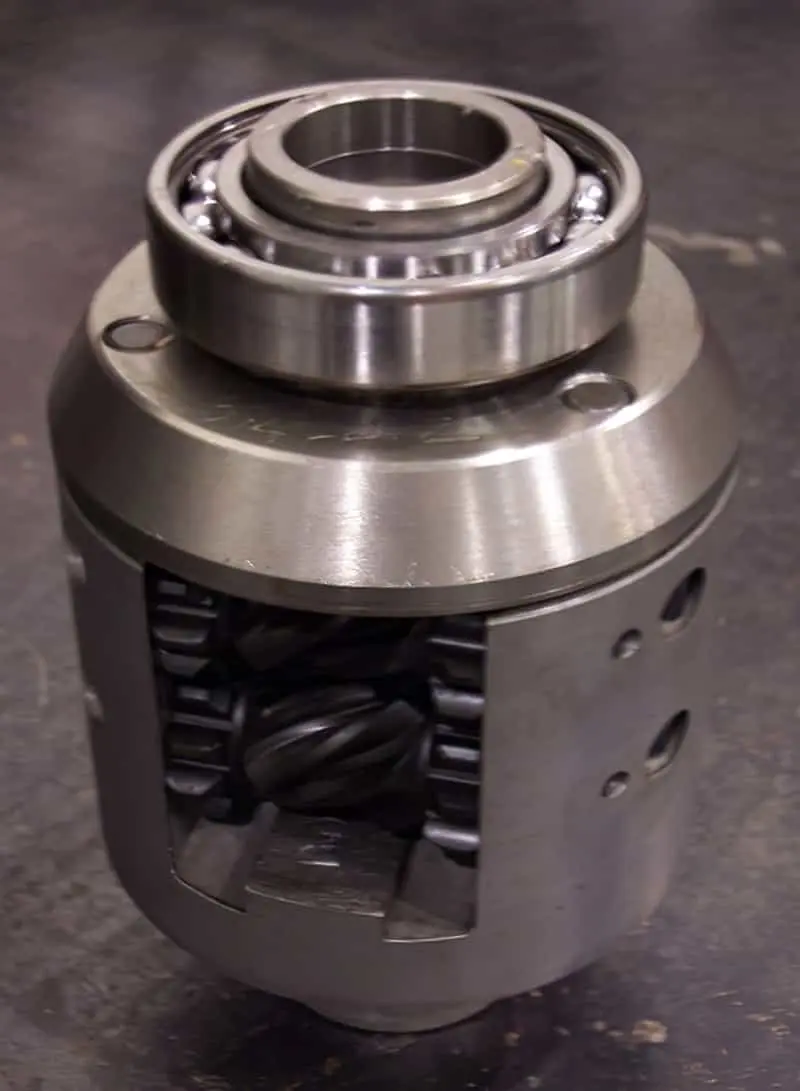
Disc limited-slip differentials, also known as clutch-type or multi-plate limited-slip differentials, are one of the most common types. Their core function is to utilize friction clutch plates to limit slip. The following details their structure, working principle, advantages, disadvantages, and applications, and discusses subtypes such as 1-way, 1.5-way, and 2-way.
Structural Analysis
Disc limited-slip differentials are based on open differentials, with the addition of a multi-plate clutch assembly. Typical structures include:
- Differential Case: It houses the gear set and connects to the input shaft.
- Side gears: connect the left and right half shafts.
- Planetary gears: allow differential speeds.
- Clutch disc assembly: alternating inner and outer discs, with the inner disc connected to the differential housing and the outer disc connected to the side gear. A thin clutch disc is typically used, with one half connected to a drive shaft and the other half to a spider gear carrier.
- Preload springs: provide initial friction.
- Ramp or Cam Mechanism: Engages the clutch when there is a torque difference. A spider gear is mounted on a pin and positioned in a beveled groove to form a cam ramp.
For example, inEatonIn the company's Posi-Traction system, the clutch plates are made of carbon fiber or metal, making them heat-resistant. Clutch stacks may exist on two drive shafts, or only one; if only one, the remaining drive shafts are connected via spider gears. LSDs are so-called mechanical LSDs with a multi-plate clutch structure. This type of LSD has not recently been adopted for mass production, but it remains an essential component in the world of motorsport. This is because the "torque offset ratio" is achieved by changing the cam angle of the pressure ring and selecting the number of clutch plates according to the application. ※This is because the "initial torque" can be freely set, resulting in excellent response to differential limiting. ((※Torque offset ratio = High μ-side torque ÷ Low μ-side torque)
A larger torque bias ratio means a greater ability to adjust the torque distribution between the inner and outer drive wheels, and can impart greater traction to the tires with better grip. Mass-produced LSDs typically have torque bias ratios between 2.0 and 3.0.

Working principle
When the wheels are moving normally and the torque is balanced, the clutch plates experience slight friction, allowing for a small slip. When one wheel slips (such as on icy or snowy roads), the torque difference causes the cam mechanism to press the clutch plates closer together, increasing friction and transferring more torque to the wheel with traction. The friction can be several times the preload value, with a typical limited-slip ratio of 1.5:1 to 3:1.
During acceleration, disc-type LSDs are more effective because the clutch plates are compressed under load. During deceleration, some designs (such as 1-way types) do not engage to avoid over-stabilization. The limited-slip torque Trq d is proportional to the input torque; the greater the input torque, the tighter the clutch engagement. Physically, this depends on the coefficient of friction μ and the normal force N, with the frictional force F = μN.
Subtype classification is based on slope symmetry:
- 2-WayThe ramp is symmetrical, providing the same Trq d for both acceleration and deceleration, making it suitable for racing and providing engine braking stability.
- 1-WayThe slope is vertical on one side (80–85°), only effective during acceleration, and open on the other side. It is suitable for front-wheel drive vehicles to avoid oversteering.
- 1.5-WayThe slope is asymmetrical, with the forward Trq d_fwd > the reverse Trq d_rev, but both are non-zero, providing an intermediate balance.
Advantages and disadvantages
advantage:
- It has a fast response time and is suitable for racing and off-roading.
- The cost is relatively low and the friction is easy to adjust (by replacing the clutch discs).
- It provides adjustable limited-slip differential and even maintains power delivery when the tires are off the ground.
shortcoming:
- Clutch discs wear out and require regular maintenance; they may need to be replaced every 60,000 miles.
- Performance decreases at high temperatures, which may cause noise or vibration.
- Under extreme conditions, overheating may lead to failure.
Application Examples
Disc-type LSDs are widely used in rear-wheel drive vehicles, such asFord MustangThe Track Pack system. In the racing field, such as...NASCARHigh-performance disc-type LSDs are used to improve cornering speed. In recent years, electronically assisted disc-type LSDs (such as...)Mercedes-AMGThe system integrates sensors to dynamically adjust friction. This is applied to muscle cars such as...Chevrolet CorvetteTo improve driving safety in winter.
Variations of disc-type LSDs include conical clutch types, which use conical elements instead of clutch plates to generate friction through engagement. When a speed difference occurs, the conical gear presses against the housing, generating a frictional torque that limits the fast-slip side. The limiting torque depends on the cone angle and is limited by the housing size.

Gear-type limited-slip differential (LSD)
Gear-type limited-slip differentials, also known as torque-sensing or Torsen-type differentials, rely on gear sets rather than friction to distribute torque. A representative product is the Torsen differential from Gleason.
Structural Analysis
Gear-type LSD has no clutch plate and is a purely mechanical structure.
- Worm Gears: The core component, consisting of a worm gear connected to a side gear and a worm connected to the housing.
- Side gears and planetary gears: similar to open gears, but with added torque bias gears.
- Housing and output shaft: Ensure gear meshing.
Torsen uses helical gears, where gear resistance automatically distributes power when there is a difference in torque. Variants include the Torsen T-1 (patented in 1958) and T-2 (designed in 1984, compatible with c-clip shafts).
Working principle
Gear-type LSDs utilize the irreversible principle of gears. During normal driving, the gears rotate freely, allowing for differential speed. When one wheel slips, the torque difference causes the worm gear to generate resistance, transferring the torque to the other side. The limited-slip ratio is fixed, typically ranging from 2:1 to 5:1, depending on the gear angle.
Unlike disc-type torque distribution, gear-type torque distribution is effective for both acceleration and deceleration (2-way type) and has no wear issues. The torque distribution ratio is determined by the gear design and requires no external control. Physically, the torque bias is based on gear friction and separation force, and Trq d increases with the input torque.
Advantages and disadvantages
advantage:
- It features no friction or wear, a long lifespan, and requires minimal maintenance.
- It operates smoothly and quietly, making it suitable for daily driving.
- It remains stable under sustained high loads, such as long-distance off-road driving.
shortcoming:
- It is costly and complex to manufacture.
- The slip ratio is fixed and not easy to adjust.
- When traction is completely lost (such as when one wheel is suspended in the air), its performance is not as good as that of a disc.
Application Examples
Gear-type LSDs are commonly used in four-wheel drive vehicles, such as the center differential in the Audi Quattro. Off-road vehicles, such as...Toyota Land CruiserUse the Torsen type to enhance off-road capabilities. High-performance vehicles such as...Porsche 911By combining a gear-type LSD with an electronic system, power distribution is optimized. Other applications include...Ford Focus RSThe Quaife ATB and Eaton Truetrac are available in 4x4 pickup trucks.
Gear-type variants include helical gears, which employ meshing left and right planetary gears to generate friction that limits the faster-rotating side when there is a speed difference. These are used in applications such as the Suzuki Escudo.

Comparison of disc type and gear type
Disc and gear-type limited-slip differentials each have their own characteristics:
- efficacyDisc type offers faster response and is suitable for aggressive driving; gear type provides a smoother ride and is suitable for long-distance driving.
- DurabilityGear-type clutches have the obvious advantage of being wear-free; disc-type clutches require maintenance.
- Cost and ApplicationDisc type is more economical and used in rear-wheel drive vehicles; gear type is high-end and used in AWD systems.
- Future TrendsBoth are moving towards electronification, such as eLSD combined with sensors.
Comparison Charts:
| Comparison items | Disc limited slip differential | Gear-type limited-slip differential |
|---|---|---|
| Core Mechanism | Friction clutch disc | worm gear |
| Limited slip ratio | Adjustable (1.5-3:1) | Fixed (2-5:1) |
| advantage | Rapid response, low cost, adjustable | Durable, noiseless, and smooth |
| shortcoming | Wear, overheating, noise | High cost, fixed ratio, weaker than zero traction |
| Typical applications | racing cars, rear-wheel drive cars | Four-wheel drive, off-road vehicle |
| Maintenance requirements | High (clutch replacement) | Low (no wear parts) |
| Torque response | Increase according to the input torque ratio | Automatic gear friction distribution |
This comparison shows that disc brakes are suitable for high-performance requirements, while gear brakes emphasize reliability. On the track, disc brakes offer 1:1 locking, while gear brakes cannot provide complete locking.
Applications and Future Prospects
Limited-slip differentials are indispensable in modern cars. Racing cars, for example...F1Advanced limited-slip differentials (LSDs) are used to improve lap times; electric vehicles such as the Rivian R1T simulate LSD functionality. Applications include sports cars, off-road vehicles, rally cars, drift cars, and track cars. In the future, with the rise of autonomous driving, limited-slip technology will integrate AI to dynamically adjust its distribution. In electric vehicles, dual-motor systems can software-simulate limited-slip, reducing mechanical complexity.
From its innovation in the 1930s to its current electronic form, the limited-slip differential has witnessed the advancements in automotive engineering. Disc and gear-based differentials have met different needs, driving industry development. Through timelines and charts, we can clearly understand its milestones. In the future, limited-slip technology will continue to evolve, adapting to the electric and intelligent era.
Further reading:
- There is a rumor circulating online that a serious incident occurred on To Kwa Wan 13th Street, openly challenging the police's law enforcement authority.
- What is horsepower and torque and where are they located?
- A man driving under the influence of drugs was finally apprehended after evading police in a GTA-style car in Tsim Sha Tsui.
- 10 Effective Modification Methods to Improve Car's Handling Performance