





[Video] How to divide shares and maintain long-term operation in a partnership

Table of contents
partnershipEntrepreneurshipThe greatest advantage lies in resource integration. One person's strength is limited, but the strength of many is boundless. Through partnerships, capital, technology, management capabilities, and market resources can be pooled to rapidly drive business development. However, partnerships are a double-edged sword; if handled improperly, not only will business failure be difficult, but it may even lead to bitter enmity, resulting in significant financial and emotional losses.
likeEquity DistributionUnfairness or unclear rules will inevitably lead to the dissolution of a partnership. The following example illustrates how to reasonably allocate equity and shares three key lock-in principles for a long-lasting partnership.
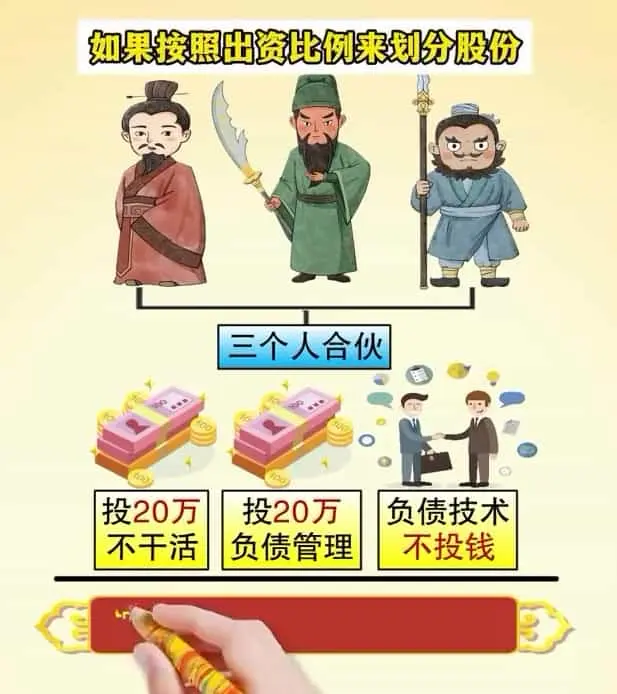
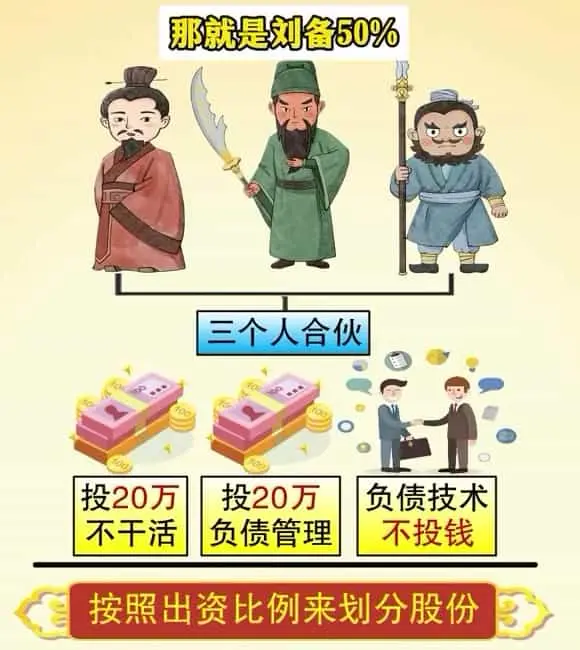
Taking Liu Bei, Guan Yu, and Zhang Fei as examples, each of them had their own strengths:
Liu Bei possessed strategic vision and brand influence (although he invested in the project, he did not directly participate in management), while Guan Yu had both management and combat capabilities (he invested in the project and contributed his strength).
Zhang Fei possesses both technical skills and execution ability (he contributed his labor but not capital). If equity is simply allocated according to the proportion of capital contribution...
Liu Bei and Guan Yu each receive 50%, while Zhang Fei receives 0%. This arrangement appears fair on the surface, but in reality, it ignores human contribution and sows the seeds of future conflict.
Why is this allocation unreasonable? Because it fails to fully assess the value of each partner. While capital is important,Technology, management, time and resourcesThese intangible investments are also crucial to business success. Ignoring them can lead to feelings of unfairness among those who contribute, resulting in a lack of motivation and even departure. Therefore, the primary task of starting a business together is to establish a sound equity distribution mechanism.
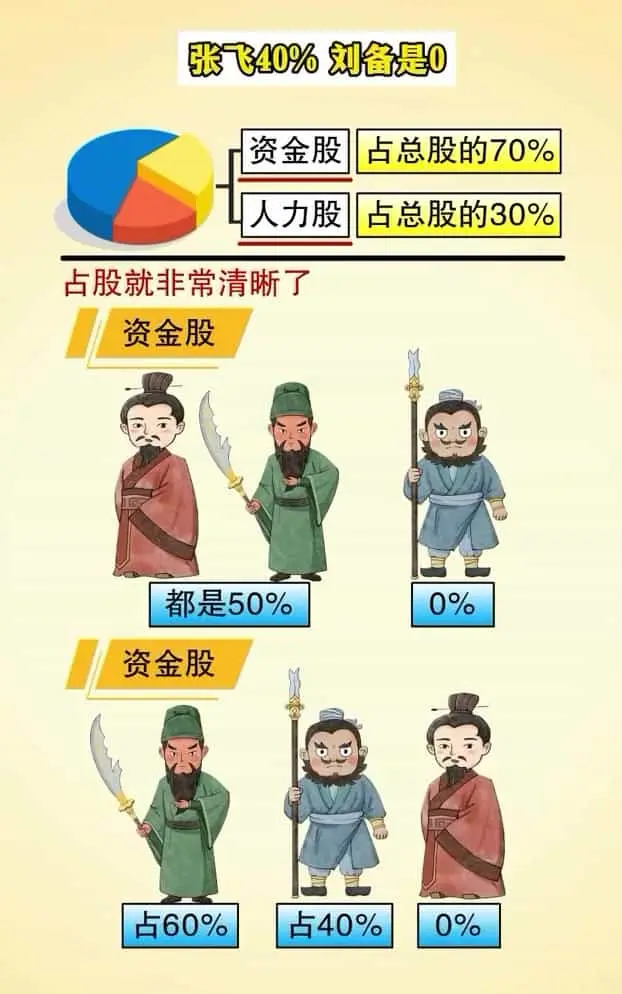
Scientific equity allocation: a combination of capital shares and human resource shares
To avoid the above problems, it is recommended to divide the equity into two parts: capital shares and human resources shares.
Capital stocks reflect monetary investment
Human resources stocks reflect intangible investments such as technology, management, and time.
The specific ratio can be adjusted according to the characteristics of the industry. It is generally recommended that capital stocks account for 60-70% of TP3T and human resources stocks account for 30-40% of TP3T.
Funds account for 70%Liu Bei invested 200,000, Guan Yu invested 200,000, and Zhang Fei invested 0. Therefore, in terms of capital shares, Liu Bei holds 50%, Guan Yu holds 50%, and Zhang Fei holds 0%.
Human resources shares account for 30%Guan Yu was responsible for management and made significant contributions, accounting for 60%; Zhang Fei was responsible for technology, accounting for 40%; Liu Bei did not directly participate in daily operations, accounting for 0%.
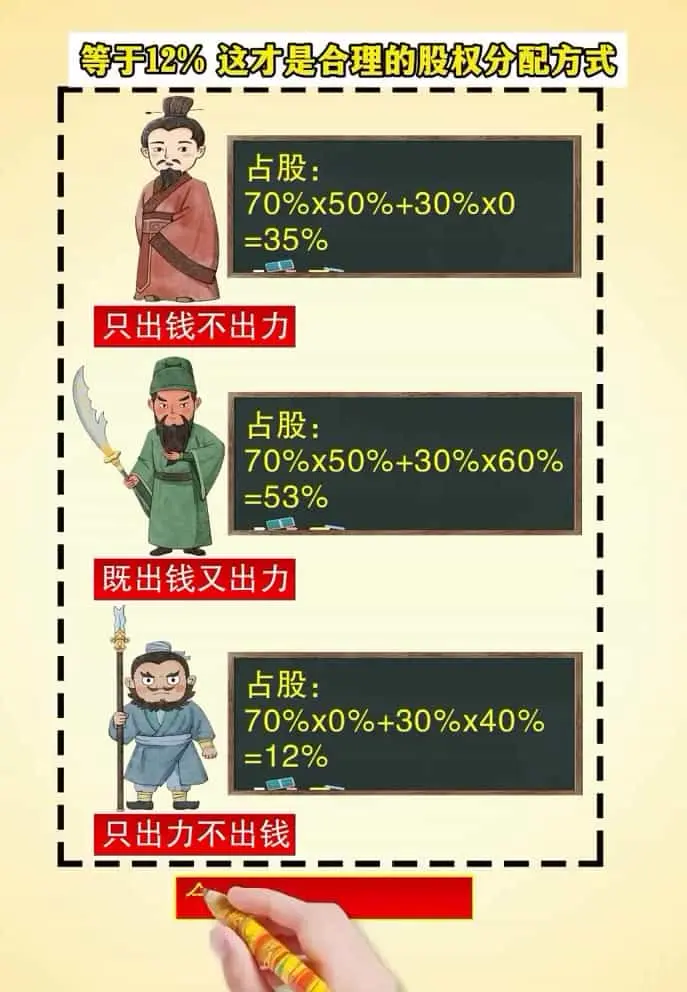
Comprehensive calculation:
- Liu BeiCapital shares (70% × 50%) + Human resources shares (30% × 0%) = 35%
- Guan YuCapital shares (70% × 50%) + Human resources shares (30% × 60%) = 35% + 18% = 53%
- Zhang FeiCapital shares (70% × 0%) + Human resources shares (30% × 40%) = 0% + 12% = 12%
This allocation method respects both capital investment and human capital, making it relatively fair and reasonable. However, equity allocation alone is insufficient to ensure the longevity of the partnership; it must be supplemented by three lock-up mechanisms.
Three Lock-in Mechanisms: Key to Ensuring Partnership Stability
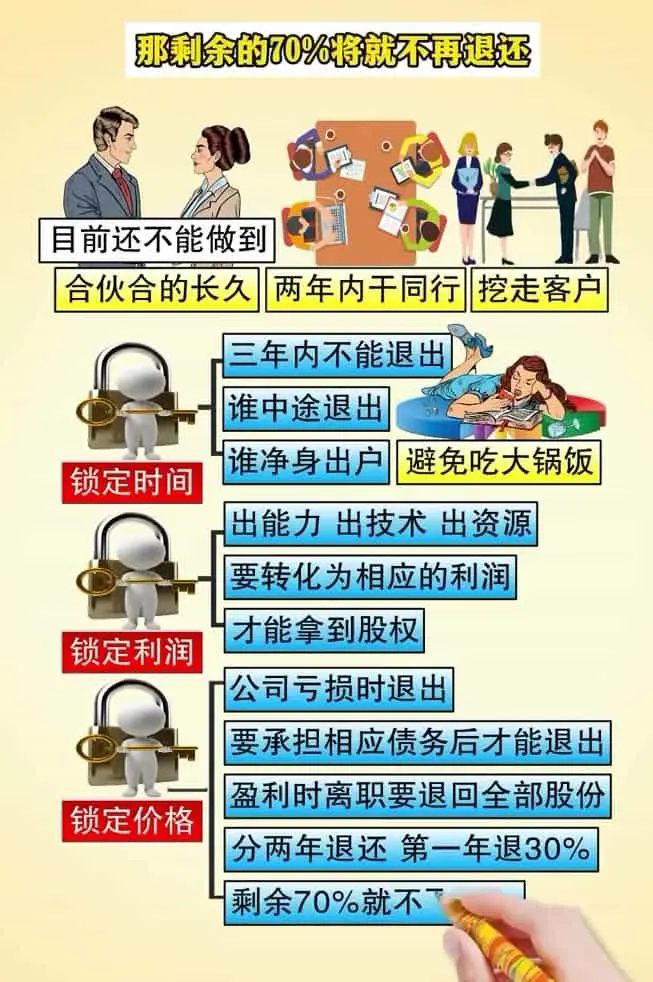
1. Time lock: to prevent mid-game exit
Partnerships require time to prove themselves and grow; therefore, a minimum cooperation period should be agreed upon (e.g., three years). During this period, no one may withdraw. Anyone who forcibly withdraws will leave with nothing, including all equity and profits. This clause prevents partners from leaving arbitrarily due to short-term difficulties or personal emotions, thus ensuring the stability of the business.
II. Locking in profits: Incentivizing continued contribution
Those who contribute capital, labor, or technology must translate their contributions into actual profits to receive corresponding equity. For example, Guan Yu and Zhang Fei must achieve preset performance targets (such as market share and technological breakthroughs) before they can officially receive human resource shares. This mechanism prevents partners from simply coasting along and ensures that each member continuously creates value for the business.

III. Locking in Prices: Standardizing Exit Procedures
The exit mechanism must be clearly defined, including:
- Exit when losses occurYou may only leave after you have assumed the corresponding debts.
- Leaving when profitableAll shares must be returned, to be refunded in two installments over two years (301 TP3T in the first year, and 701 TP3T in the second year). If the company engages in the same industry and poachs customers within two years, the remaining 701 TP3T will not be refunded.
This clause protects the interests of the company and other partners, preventing cutthroat competition and resource loss.

Essential Legal Agreement: A Written Agreement Protects Your Rights
Starting a business together is a commercial transaction and cannot rely on emotions or verbal promises. The following agreement must be signed to clearly define rights, responsibilities, and benefits:
- Capital Investment AgreementRecord in detail the amount of investment, method, time, and equity ratio to avoid future disputes.
- Agreement on concerted actionTo ensure that partners agree on major decisions and prevent internal divisions.
- Confidentiality AgreementProtect the company's trade secrets, technology, and customer information, and prevent their leakage.
- Exit AgreementClearly define the exit conditions, price, and method to protect the rights and interests of both parties.
These agreements should be drafted by professional lawyers, with each person receiving a copy, and reviewed and updated regularly.
Successful partnerships rely on rules, not emotions.
The purpose of starting a business together is to make money, and the core lies in clear profit distribution and rules, not just emotional bonds. If you rely solely on feelings and ignore a written agreement, the partnership will inevitably collapse sooner or later, and may even lead to financial ruin.
Only through scientific equity allocation, three lock-up mechanisms, and comprehensive legal agreements can partnership risks be minimized, allowing the business to grow steadily. If Liu Bei, Guan Yu, and Zhang Fei had adopted these methods in the early stages of their ventures, they might have avoided historical regrets and created a brilliant future together. Cooperation and mutual benefit are possible, but the prerequisite for a win-win situation is clear rules and a fair structure.
Therefore, regardless of the size of the business, partners should maintain a professional attitude and prioritize rules over emotions. Only in this way can they remain invincible in the business arena and achieve long-term success. Regardless of company size, the following four agreements should be prepared at the beginning of the partnership, and each partner should be ensured to sign them:
- Capital Investment AgreementClearly define the amount of investment, equity ratio, and method of fund use.
- Agreement on concerted actionEnsure that partners are aligned on major decisions.
- Confidentiality AgreementProtect company trade secrets and prevent the leakage of technology or customer information.
- Exit AgreementStandardize exit conditions, equity return methods, and liability for breach of contract.
Summarize
For a partnership to succeed, it must balance capital and human resource contributions in equity distribution and ensure stability by locking in time, profits, and exit prices. All rules must be clearly written down to avoid emotional decisions. Only partnerships built on fair interests and strict rules can go the distance, remain invincible in the business world, and achieve long-term success.
![[有片]拜祖先會獲得保佑?](https://findgirl.org/storage/2026/01/有片拜祖先會獲得保佑?-300x225.webp)