





Sperm competition mechanism

Table of contents
Sperm competition(Sperm Competition) is a type of competition inPolygamy(polyandry) is a common biological phenomenon in the environment, referring to the process by which sperm from two or more different males compete to fertilize the same egg in the same female.
This mechanism not only affects an individual's reproductive success rate but also drives evolutionary adaptations, such as changes in genital morphology, sperm count, and quality. This phenomenon can be observed in the animal kingdom, from insects to mammals, and even extends to discussions in human evolutionary psychology. Understanding sperm competition helps explain why some species have developed complex mating strategies and their applications in reproductive medicine and conservation biology.
Sperm competition is everywhere. Research shows that...Social monogamyIn some species, as many as 10-701 TP3T of offspring still result from extramarital mating. This phenomenon drives a variety of astonishing phenomena.Biological adaptationFrom the special morphology of sperm to the complex mating behavior of males, these are all competitive strategies formed over hundreds of millions of years of evolution.

Definitions and basic concepts
definition
Sperm competition is defined as the process by which sperm compete for fertilization opportunities within the female reproductive tract when a female mates with two or more males during a reproductive cycle. This competition presupposes female multiple mating, leading to spatial and temporal overlap of sperm. This is not merely a random event but also involves male strategies to maximize the advantage of their own sperm.
Sperm competition can be divided into "passive" and "active" forms: passive refers to the advantage of sperm quantity or quality, while active involves the removal or obstruction of rival sperm. Scientists estimate that in polygamous species, this mechanism can determine fertilization success rates as high as 90%.
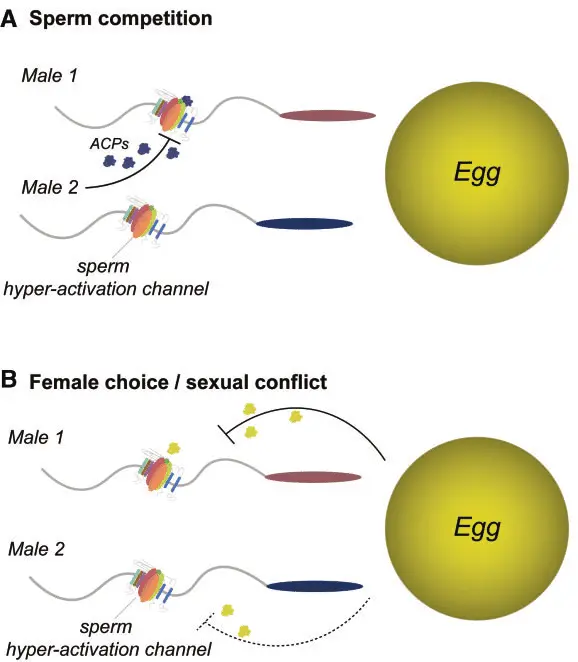
Basic Concepts
- PrerequisitesFemales mate with at least two males, and their sperm lifespans overlap.
- Competition levelThis includes pre-ejaculatory (such as courtship competition) and post-ejaculatory (such as the interaction of sperm within the reproductive tract).
- Sexual ConflictMale strategies may harm female health, leading females to evolve countermeasures, such as selective sperm storage.
This concept emphasizes that sperm competition is not only an extension among males, but may also be used by females as a tool for selecting superior genes.

Historical Development and Timeline
The development of the sperm competition theory can be traced back to the mid-20th century, maturing with the rise of evolutionary biology. The table below presents key time periods and events, demonstrating the evolution from conceptualization to empirical research.
| Time period | Year Range | Key events and contributions | Key Investigators/Discoveries | Influence |
|---|---|---|---|---|
| genesis | 1940s-1960s | Early observation of polygamy; preliminary conceptualization of sperm competition. | Early biologists such as Robert Trivers (parental investment theory). | The foundational evolutionary framework connects sperm competition with parental investment. |
| Theory Establishment Period | 1970s | Parker proposed the sperm competition theory, emphasizing competition after ejaculation. | Geoffrey Parker (1970) | This is the first systematic definition that initiates research into quantitative models. |
| Empirical extension period | 1980s-1990s | Animal experiments have confirmed mechanisms, such as the association between sperm removal and testicular size. | Parker and his team; Birkhead (1998) | Introduce data, such as the positive correlation between testicular size and competitive intensity. |
| Molecular and Human Application Period | 2000s-2010s | Neurological and genetic research; proposal of the human sperm competition hypothesis. | Gallup et al. (2003); Simmons (2001) | Linking human genital morphology; fMRI studies sperm quality. |
| Contemporary Integration Period | 2020s | Integrating AI simulations with cross-species comparisons; a discussion on reproductive health after COVID-19. | multidisciplinary team | It is applied in conservation and medicine to predict the impacts of climate change. |
This timeline shows that sperm competition has grown exponentially from the theoretical framework of the 1970s to the molecular evidence of the 2000s. Parker's 1970 paper marked a turning point, emphasizing the raffle principle, which states that the higher the sperm count, the higher the chance of fertilization.

Mechanism Explanation
Sperm competition mechanisms are divided into defensive and offensive adaptations, as well as the influence of female selection.
defensive mechanisms
Designed to prevent the opponent from mating or entering:
- Mate-guardingMales monitor females and prevent other males from approaching. Example: In the fish *Neolamprologus pulcher*, males guard females to prevent outsiders from mating.
- Copulatory PlugsAfter mating, a physical barrier is inserted to block subsequent sperm. This is commonly seen in insects, reptiles, and mammals; for example, bumblebees use plugs containing linoleic acid to reduce the likelihood of females mating again.
- Toxic substances in semenDrosophila melanogaster releases accessory gland proteins (ACPs) that inhibit females from mating and stimulate ovulation.
- Sperm PartitioningMales control sperm production, reserving it for multiple females. Blue-headed parrotfish (Thalassoma bifasciatum) have sperm chambers that regulate sperm release.
- Prolonged matingIn insects, this prolongs mating time to prevent females from finding another mate.

Offensive mechanisms
Designed to remove or destroy the opponent's sperm:
- Physical removal of sperm: Using the genitals to remove previous sperm, such as the beetle Carabus insulicola which is excised with a hook-like structure.
- Semen toxinsFruit fly semen contains enzymes that destroy sperm, although some studies suggest it may have a protective effect.
- Last Male PrecedenceThe male has a high fertilization rate during the final mating, as seen in the cumulative advantage achieved by flies such as Dryomyza anilis.
Female selection mechanism
Females can actively select high-quality sperm, such as by storing or expelling specific sperm through reproductive tract structures. For example, in the spider *Nephila fenestrate*, females use fragmented reproductive organs as plugs.

Species Examples and Data Display
example
- insectFruit flies use toxic semen; black-winged damselflies use their penises to brush away the sperm of their opponents, with a removal rate of 90-100%.
- FishCichlids have evolved to produce more and faster sperm; blue-headed parrotfish distribute sperm.
- mammalsElephants and seals protect themselves through violent competition; yellow squirrels have higher reproductive success rates due to larger testicles.
- birdsThe warbler pecks away the previous sperm.
- humansThe coronal ridge of the penis may remove semen from the opponent, according to a 2003 study.
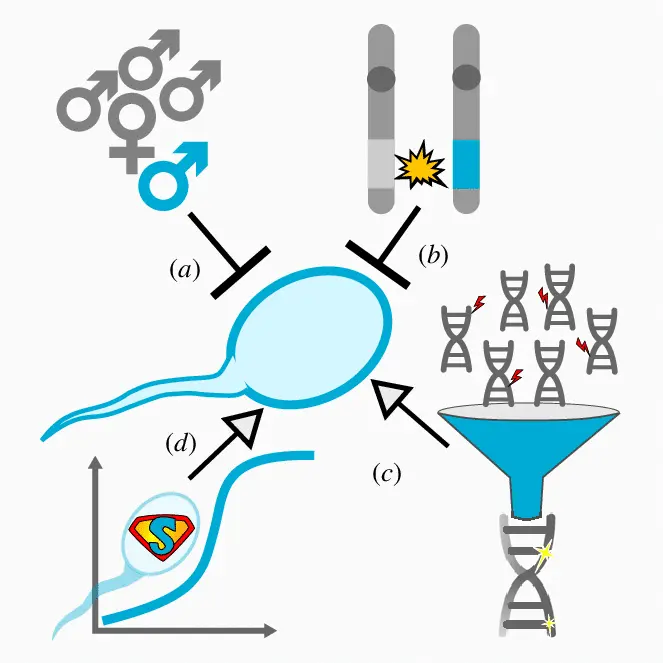
Comparison of sperm specialization in different species
| Species | Sperm characteristics | competitive advantage |
|---|---|---|
| fruit flies | Giant sperm (up to 6cm in length) | Physically blocking the female reproductive tract |
| mouse | Hook-shaped head | Sperm clusters form and swim in unison. |
| humans | Two types of sperm: normal and blocking. | Blocking sperm hinders competitors |
| Duck | Spiral head | Adaptation to a spiral reproductive tract |
Data and Charts
The following table summarizes the key data.
| Species/Mechanism | Competition intensity index (testicular size relative to body weight 1TP 3T) | Sperm removal rate (%) | Final male dominance rate (%) | Source Year |
|---|---|---|---|---|
| Chimpanzees (highly competitive) | 0.27 | N/A | 80-90 | 1990s |
| Gorillas (low competition) | 0.02 | N/A | <50 | 1990s |
| fruit flies | N/A | 50-70 | 70 | 1970s |
| Black-winged Damselfly | N/A | 90-100 | high | 1980s |
| Yellow squirrel | Add 15-20% | N/A | N/A | 2000s |
Relationship between testicular size and mating system
| Mating system | Representative species | Testicular weight/body weight | Sperm production |
|---|---|---|---|
| Monogamy | gorilla | 0.02% | Low |
| Polyandry | chimpanzee | 0.30% | high |
| Polygamy | Chimpanzees | 0.05% | medium |
X-axis: Competition intensity (low-high); Y-axis: Testicular size ratio. An upward-sloping line indicates a positive correlation, such as a tenfold increase in testicular size from gorillas to chimpanzees in primates.
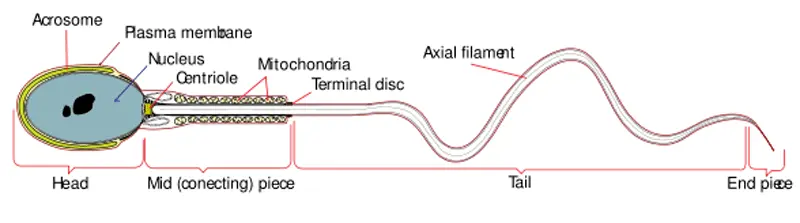
(A diagram of human sperm structure, illustrating morphological adaptation in competition.)
Evolutionary significance and reasons
Evolutionary significance
Sperm competition drives the evolution of the reproductive system, such as the diversification of penile morphology (the human coronal crest hypothesis) and sperm cooperation (the wood rat sperm train, which increases swimming speed). Testicular size is positively correlated with the intensity of competition: highly competitive species have larger testicles to produce more sperm.
reason
- Evolutionary pressurePolygamy increases genetic diversity, but it triggers male investment strategies.
- Physiological basisSperm count model (raffle): Quantitative advantage determines the outcome.
- Environmental factorsHigh-density populations amplify competition.
This mechanism explains the conflict between sexual dimorphism and reproduction.
Sperm competition mechanisms reveal the complexity of reproductive evolution, from defensive embolism to offensive removal, all adaptations aimed at maximizing gene dissemination. Through historical timelines and data, we can see its development from 1970s theory to contemporary applications. Future research could integrate genomics to explore human applications, such as infertility treatment. Sperm competition is a highly explanatory theoretical framework in evolutionary biology, playing a crucial role in shaping biodiversity, from microscopic sperm structure to macroscopic social behavior.

Human sperm competition
In humans, the legacy of sperm competition continues to influence our reproductive biology, sexual psychology, and social relationships.
Physiological adaptation
Human males exhibit several physiological adaptations for sperm competition:
Testicular sizePrimates that fall between monogamy and polygamy.
Sperm productionApproximately 100-200 million sperm are produced daily, indicating a moderate level of competition.
Semen compositionIt contains chemicals that may affect other sperm.
Behavioral adaptation
Signs of competition in human sexual behavior:
frequency of sexual intercourse: Higher than the reproductive requirement, may have a competitive function.
Ejaculation volume adjustmentThe longer the separation from the partner, the greater the amount of ejaculate.
Sexual arousal levelSexual arousal is enhanced when imagining competitive situations.
Psychological evidence
Sexual psychological adaptation
The psychological mechanisms of sexuality predicted by the sperm competition theory:
Sexual arousal patternsMen have complex reactions to the imagination of their partner's infidelity.
Jealousy DifferencesMen are more concerned about sexual infidelity, while women are more concerned about emotional infidelity.
Sexual fantasy contentIt often contains elements of sperm competition.
Partner Selection and Guardian
Human males have developed a variety of mate protection strategies:
Direct Guard: Monitoring and restricting a partner's interactions with other men
Emotional manipulationStrengthening relationship bonds through love and commitment
Resource DisplayDemonstrating parenting skills increases partner loyalty.

The Time Dimension of Sperm Competition
Evolutionary timescale
The evolution of sperm competition is a long process that can be traced back to early sexually reproducing organisms. In primates, the ratio of testicular size to body size is closely related to the evolution of the mating system.
Timeline of Primate Sperm Competition Evolution
| Time | Evolutionary events | Development of competitive characteristics |
|---|---|---|
| 60 million years ago | The earliest primates | Basic reproductive characteristics |
| 30 million years ago | Old World Monkeys | Differences in testicular size begin to appear |
| 15 million years ago | Hominoid differentiation | medium testicular size |
| 5 million years ago | Human racial differentiation | Formation of human-specific characteristics |
Individual life cycle
Sperm competitiveness changes throughout an individual's life cycle:
pubertyCompetitive capabilities begin to develop
AdolescenceSperm quality and quantity are at their best during peak competition periods.
middle ageGradually decreasing, but strategic behavioral compensation
old ageCompetitive ability significantly reduced
Immediate response mechanism
Sperm adjustment in the face of competitive threats:
Short-term adjustmentAdjusting sperm allocation from minutes to hours
Mid-term adaptationAdjusting sperm production within a few days
Long-term adaptationContinuous exposure to a highly competitive environment for months to years leads to physiological changes.
Understanding sperm competition is not only scientifically valuable, but also helps us gain a more comprehensive understanding of human nature. It allows us to respect our biological heritage while using reason and culture to create more harmonious relationships and social systems. As renowned evolutionary biologist Geoffrey Parker stated, "Sperm competition reveals a hidden world where microscopic intercellular competition shapes the macroscopic world we see." Future research will continue to unravel the mysteries of sperm competition, providing further insights into the evolution of life and human nature. Developments in this field also remind us that humans are both products of biological evolution and creators of culture, possessing the capacity to transcend mere reproductive drive while understanding our biological heredity.
Further reading: