



A firefighter who deliberately lured his girlfriend to his workplace and raped her was sentenced to eight and a half years in prison.
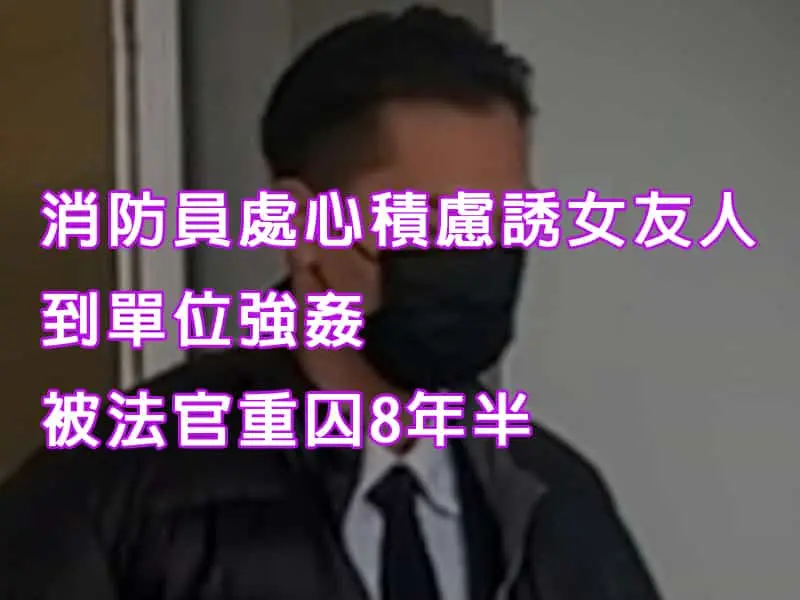
July 9-10, 2021, formerfirefightersChan Kwan-Chun (34 years old at the time of the incident) was charged on Castle Peak Road, New Territories.Tinglan ResidenceIn a serviced apartment room, the female victim, X, was raped. (2023)High CourtjuryHe was convicted of rape by a large margin of 6 to 1 and sentenced to eight and a half years in prison by Special Judge Guo Dongming on March 30, 2026.
Table of contents
Case Summary Table
| project | content |
|---|---|
| Case Number | HCCC93/2023 |
| defendant | Chen Junjun (34 years old, a firefighter at the time of the incident) |
| charges | One rape charge |
| Date of the incident | July 9-10, 2021 |
| Location of the crime | Serviced apartments at Ting Lan Court, Castle Peak Road, New Territories |
| victim | X (adult female, friend of the defendant) |
| Key evidence | X testimony, CCTV footage, expert witness testimony (BDO features), defendant's statement |
| Toxicological results | No drug was detected in X (because the detection window period has passed). |
| Jury verdict | A 6-1 verdict found the defendant guilty of rape. |
| sentencing judge | Special Judge Guo Dongming |
| Sentence | 8 years and 6 months imprisonment |
| Factors that aggravate punishment | Premeditated, drug use (highly likely), no condom used, the victim suffers from PTSD, shows no remorse, and exploits professional trust. |
| Factors for sentence reduction | None (the defendant's background was not accepted as a reason for sentence reduction). |
| Main legal provisions | Section 118 (Rape) of the Crimes Ordinance (Chapter 200) |
The core dispute in this case is not whether sexual intercourse occurred, but rather whether the female victim was in a state of non-consent, and whether the defendant knowingly or disregarded this state while engaging in sexual intercourse. The prosecution successfully proved that the defendant used premeditated means ("Date rape drug"GHBThe defendant caused X to fall into a state of dizziness and loss of consciousness. Afterwards, he did not use a condom, leaving X to endure the fear of pregnancy. Although the defendant claimed that he "did not know that the liquor was drugged" and that he "could not help himself," the judge and jury both believed that his testimony was unreliable, and the chain of evidence pointed to a planned crime and a lack of remorse, which aggravated the circumstances.
The sentencing in this case took into account deterrence, clearing the victim's name, and the fact that while the defendant was not inherently a bad person, his mitigating circumstances were limited given the severity of his crimes. The following analysis breaks down why the court found the defendant guilty.

How the foundation of trust established between the two parties was exploited as an opportunity for crime.
X and Chan Kwan-Chun met through friends in mid-April 2021 and remained online acquaintances. They had dinner together at Harbour City, after which X began dating another man, and their contact decreased. However, because they played mobile games together, X learned of the defendant's birthday on July 1st and sent him birthday wishes, indicating that they maintained a low level of contact. On July 9th, they went to see a movie together, and the atmosphere appeared amicable.
The defendant exploited the noble image of a "firefighter" to lower X's guard. Judge Guo Dongming clearly pointed out that although the relationship between the two did not reach the level of "breaking trust," X was "unguarded" precisely because of the defendant's profession. This became an important background—the defendant was not a stranger, but an "acquaintance" whom X was willing to meet based on society's positive stereotypes of firefighters. This exploitation of trust is a typical characteristic of premeditated crime.
The defendant suggested cooking at a serviced apartment to save on corkage fees, thus shifting their public date to a private space. X agreed and arrived at the Ting Lan Court apartment in Tsuen Wan around 10 PM, where the defendant was already there. The two ate dinner and drank the defendant's own liquor, followed by a card game. This seemingly normal process became the key starting point for the prosecution's evidence of "premeditation": the defendant's proactive arrangement of a secluded environment and provision of alcohol were precisely to create an opportunity for X to "black out."

Timeline of the day of the incident: From normal drinking to the turning point of "dizziness and loss of consciousness"
X testified in court that after drinking the liquor brought by the defendant, she felt dizzy and weak in her limbs, and then lost consciousness. She woke up around 4 a.m., still feeling dizzy. She told the defendant that she had "slept for several hours," and the defendant responded, "You're not very dizzy," and then proactively told her, "You and I did something." X was shocked and asked, "Where did you ejaculate?" The defendant initially did not answer, but after repeated questioning, he finally said, "I ejaculated outside."
At this moment, fragmented images flashed through X's mind: she and the defendant were having sex in bed, the defendant had said "It feels so good," and she kept saying "No." X immediately sent a voice message to her sister, describing how she felt dizzy after drinking the liquor the man had brought, and how she didn't know what had happened after she regained consciousness. After returning home at around 10 a.m. the next morning, she called her sister and told her directly that she had been drugged and raped. During the conversation, she recalled feeling mucus in her lower right abdomen, confirming that there had been contact with bodily fluids. Because she still felt weak, she didn't report the incident to the police until noon.
The prosecution presented multiple CCTV footage clips showing the defendant helping a clearly weakened X leave Ting Lan Residence. X stated in court that he had no recollection of this. This CCTV footage served as irrefutable evidence, proving that X was already in a drug-induced weakened state when he left, rather than being "conscious and voluntary."
During his testimony, the defendant insisted that he "did not know the liquor contained drugs" and described the sexual act as "uncontrollable." However, the jury questioned this, indicating that they doubted whether the defendant was truly unaware. Judge Guo Dongming explicitly rejected the defendant's statement during sentencing, stating that this case was "not a momentary impulse or uncontrollable act, but a premeditated crime."

Drug Mystery: Although BDO was not detected in the body, environmental evidence is sufficient to prove the use of "date rape drugs".
Properties of Butanediol (BDO)
The most attention-grabbing element in this case is the "date rape drug"—1,4-butanediol (BDO). This type of drug is colorless and odorless, easily added to alcohol, and metabolized rapidly, often dissipating within hours, making it difficult to detect in the victim's body. Once ingested, BDO is rapidly metabolized into gamma-hydroxybutyric acid (GHB), commonly known as "G-water." Its characteristics include:
- Colorless, tasteless, odorlessIt can be easily mixed into liquor without being detected.
- Fast-actingDizziness, muscle relaxation, drowsiness, and amnesia may occur within 15 to 30 minutes after drinking.
- Rapid metabolismThe half-life is about 30 to 50 minutes. After 4 to 6 hours, the concentration in the blood is extremely low, and after 12 hours, it is almost undetectable in the urine.

Why can a crime be committed even if no drugs are detected?
X consumed alcohol between approximately 10 and 11 PM on July 9th and woke up around 4 AM on July 10th. The police were called and samples were taken between dawn and noon. Approximately 12 to 15 hours passed between the alcohol consumption and sample collection, far exceeding the detection window for BDO/GHB. Therefore, the absence of the drug in the test results is entirely in line with forensic expectations and does not negate the possibility of the drug's presence.
Although the prosecution failed to detect BDO in X's body, expert witnesses and CCTV evidence indicated that X was "affected by drugs" at the time: dizziness, loss of consciousness, continued weakness upon waking, and memory loss—symptoms highly consistent with BDO intoxication. Judge Guo Dongming stated during sentencing that "the drug involved was most likely a date rape drug," but because it could not be detected, he did not charge X with drug administration. However, this does not affect the establishment of the rape charge—as long as it can be proven that X was unable to consent to sexual intercourse due to the drug, the "no consent" requirement is met. Even if the defendant is not charged with "drug administration," his "providing of liquor" and "knowing or disregarding that X was unconscious" still constitute the necessary mental state for rape.

The key role of environmental evidence
The chain of environmental evidence in this case includes:
- X's normal health condition and alcohol tolerance.
- Sudden, deep, and disproportionate dizziness and loss of consciousness in response to alcohol consumption.
- The symptoms of memory loss and amnesia are consistent with those of GHB drugs.
- He remained weak after waking up, and CCTV confirmed that he needed assistance.
- The defendant proactively informed me that "you did something with me," rather than asking for my consent.
- Experts speculate that it is most likely BDO.
This is the key point in the jury's 6-1 guilty verdict: they were satisfied with X's credible testimony and believed that the defendant used drugs to create a state of "inability to resist and being at the mercy of others." The defendant claimed that he "drugated" X, but the jury believed that his actions of arranging private space, bringing alcohol, and helping X away afterwards formed a complete premeditated chain of events, exceeding a reasonable doubt.

Aggravating factors for the defendant's conduct: bringing a condom but not using it, not asking for consent, and attitude afterward.
The judge specifically emphasized three factors that aggravated the sentence:
- PremeditatedThe defendant brought condoms that day but did not use them. This reflects that he had planned to have sex with X, but disregarded X's inability to consent. The failure to use a condom caused X immense fear of pregnancy afterward, exacerbating her psychological trauma.
- No preventative measures were used.The judge rebuked the defendant, stating, "Even though condoms were available, the defendant's failure to use them demonstrates that he was only concerned with satisfying his own desires and completely disregarded X's health and wishes." The judge further stated, "The defendant's failure to use condoms, even when they were readily available, exacerbated X's fear of pregnancy."
- Leveraging Trust and Professional ImageX was unsuspecting because of the defendant's status as a firefighter, and the defendant exploited this trust to commit the crime. The judge pointed out, "X was unsuspecting because of the defendant's noble profession."
The defendant never mentioned in court that he asked X "whether she needed a condom" or provided any confirmation of consent, further proving that X was unable to express her will at the time. The judge rebuked the defendant, stating that he knew X was "unable to resist" yet still committed violence.

The victim's trauma report: PTSD severely impacts social and partner relationships, proving the consequences of the crime.
X's trauma report indicated that she suffered from post-traumatic stress disorder (PTSD), with typical symptoms including:
- Intrusive memoriesFragmented images of being sexually assaulted involuntarily surface in my mind.
- avoidance behaviorAvoid places and people related to the case, and develop a fear of the opposite sex.
- Negative emotions and cognitionFeelings of self-blame, shame, and loss of trust in others.
- over-vigilanceInsomnia, easily startled.
The report indicated that PTSD severely impacted X's social life and ability to find a partner, requiring long-term psychological treatment. The judge cited this report, emphasizing the lasting harm caused to X by the defendant's actions, and stressed that sentencing must consider "redressing the victim's grievances."
This also proves that the defendant's claim of "being unable to control himself" is unreliable—if it was a momentary impulse, he should have felt remorse afterward, but the defendant's letter of mitigation made no mention of X, showing that he only cared about his own consequences.

The defendant's letter of mitigation revealed a complete lack of remorse: the person he apologized to downplayed the severity of the situation.
The defendant wrote two letters of mitigation, both beginning with: "I would like to offer my sincerest apologies for the impact this case has had on my family, friends, colleagues and the general public." Judge Guo Dongming pointed out: "I cannot see any impact this case has had on the defendant's colleagues or the general public. On the contrary, X, who was the most deeply affected, has not received the slightest apology."
Although letters of mitigation from relatives and friends stated that the defendant was "not inherently a bad person and was responsible to his family," the judge believed that background mitigating factors were limited given the severity of the crime. The defendant's statement in prison that he would "improve himself" did not change the judge's assessment that he showed no remorse.
This is crucial: in Hong Kong courts, remorse is a significant factor in sentencing. A defendant's complete lack of remorse greatly weakens their plea for leniency, leading to sentences that are more deterrent and punitive.

Legal Requirements Analysis: How is Rape (Chapter 200 of the Hong Kong Crimes Ordinance) Applied?
The statutory elements of the crime of rape
Under Hong Kong law, rape is primarily governed by section 118 of the Crimes Ordinance (Chapter 200). The prosecution must prove three elements:
- Man and woman engage in illicit sexual intercourseThis refers to the penis entering the vagina, regardless of ejaculation or the degree of penetration.
- The woman did not consent at the time.Consent must be voluntary, informed, and within the capacity to make a genuine choice. If someone is unable to make a genuine choice due to intoxication, drugs, or unconsciousness, it is legally considered "no consent."
- The defendant knew that the woman did not agree.Or at least recklessly disregard her consent.
Application of this case
- actus reus (criminal behavior)Sexual intercourse occurred, and X lost consciousness, experienced memory loss, and had fragmented recollections afterward indicating that he could not consent.
- Mens Rea (Criminal Psychology)The defendant later told us that he had done something and described it as "very comfortable," indicating that he was aware of X's condition at the time but still continued.
The jury was satisfied with the prosecution's case and had eliminated reasonable doubt. The defendant's defense of "not knowing when the drug was administered" was overturned because, even without direct evidence that he personally administered the drug, the prosecution could still prove through circumstantial evidence that he "knew or disregarded" it—arranging a private space, providing alcohol, and his subsequent attitude all pointed to this.
The judge also considered that social events and the pandemic caused delays in prosecution, but these did not affect the conviction verdict; he only briefly explained the time pressure.

The significance of a 6-1 jury verdict: collective wisdom in determining the facts.
In Hong Kong High Court rape cases, verdicts are handed down by a seven-person jury, requiring at least five jurors to agree for a conviction. In this case, the 6-1 verdict indicates that the vast majority of jurors accepted the X-evidence, expert opinions, and CCTV footage, finding the defendant guilty. The jury's questioning regarding whether the liquor contained drugs reflects their careful consideration, but the final guilty verdict demonstrates that the chain of evidence exceeded a reasonable doubt.
Dissenting jurors may have had doubts about the absence of drugs or believed that X might simply be intoxicated. However, the 6-1 result indicated that the majority of jurors accepted the prosecution's chain of circumstantial evidence and rejected the defendant's defense of "lack of knowledge."

Summary of sentencing rationale: deterrent effect, exoneration of wrongful conviction, and factors that could lead to a harsher sentence outweigh all else.
Judge Guo sentenced him to eight and a half years in prison based on the following factors:
- Factors that aggravate punishment: Use of medication (most likely BDO), premeditation, failure to use a condom, exacerbation of fear of X-pregnancy, exploitation of professional trust, the victim suffers from PTSD.
- No regretsThe letter of appeal avoided mentioning X, and only apologized to the public and colleagues.
- Limited background pleaAlthough not a bad person, his crimes were serious.
- The deterrent effect and the need to clear X's name must be considered.The sentence should "clear up the wrongful conviction of X".
Eight and a half years is considered above average, reflecting the court's strict attitude towards such "familiar person rape" cases. In similar cases, the use of drugs and lack of remorse afterward will significantly increase the sentence.

Social significance: The gap between a noble professional image and crime.
This case serves as a reminder to the public that professional image cannot be a shield from punishment. Firefighters, who should be symbols of public trust, were exploited by the defendant to commit crimes, further highlighting the heinousness of the offense. Through sentencing, the court conveys the message that "regardless of background, those who break the law will be punished."
Meanwhile, this case establishes an important principle: toxicological evidence is not always necessary in date rape cases. As long as the victim can clearly describe the process of losing consciousness, and expert witnesses explain the drug's properties and metabolism time, along with the defendant's behavioral patterns, the jury can convict based on circumstantial evidence. This is significant in encouraging victims of date rape to bravely report the crime.

The chain of evidence is complete and all legal requirements are met; therefore, the guilty verdict is beyond doubt.
Based on the above analysis, the reasons for the defendant Chen Junjun's conviction are clear:
- The evidence provided by X is consistent and corroborated by CCTV and experts.This proves that they have lost the capacity to give consent.
- The defendant's actions showed premeditation and disregard for X's condition.Arrange for private space, bring your own liquor, and bring condoms but don't use them.
- Although the drug effect was not directly detected, there was sufficient environmental evidence.Symptoms, timeline, expert witnesses, defendant's statement.
- The defendant's lack of remorse is an aggravating circumstance.The letter of appeal completely ignores X.
- The jury and judge both ruled out a reasonable doubt.The elements of the crime of rape apply.
This case, from the initial dating to the issues of private space, drug influence, sexual assault, concealment afterward, and the downplaying of the severity of the crime during pleas for leniency, forms a complete picture of the crime. The court's response of eight and a half years in prison is precisely to protect the victim, deter potential offenders, and uphold judicial justice.