



Erotic Metaphors and Cultural Tension in Chinese Classical Poetry
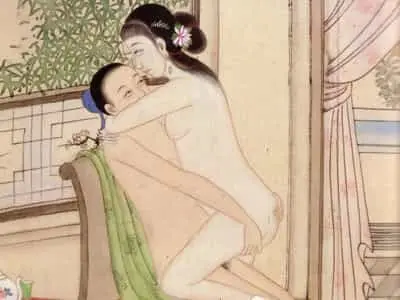
Table of contents
The flower-lined path has never been swept for guests, but today the humble gate is opened for you.
"The flower-lined path has never been swept for guests, but today the humble gate is opened for you." This couplet by Du Fu, seemingly describing idyllic rural life, has evoked countless ambiguous associations over the centuries. In the long river of classical Chinese literature, erotic descriptions have always been like an undercurrent, sometimes visible, sometimes hidden, neither openly proclaimed nor completely suppressed. This unique "metaphorical eroticism" has created a special aesthetic taste in Chinese literature—using flowers to symbolize women, and clouds and rain to symbolize intercourse, transforming the most private matters of the bedroom into the most elegant artistic expression.
Erotic puns
Chinese erotic poetry has distinct artistic characteristics. Firstly, it employs widespread use of imagery substitution, with "flower heart" representing the female genitalia, "jade stem" representing the male phallus, and "clouds and rain" representing intercourse. Secondly, it utilizes numerous puns, such as "playing the flute" referring both to musical performance and implying...oral sexThe most important aspect is the "art of leaving blank space," which inspires greater imagination by not explicitly stating the facts. For example, Li Yu's "barefoot on the fragrant steps, carrying golden embroidered shoes in hand" only describes the action of Xiao Zhouhou taking off her shoes during her night visit, yet it leaves room for imagination about what happened next.
This unique form of erotic expression is closely related to the traditional social structure of China.Of all evils, lust is the worst.Under the moral norms of Confucianism, the expression of desire had to find a form that conformed to "propriety." Scholars were constrained by Confucian ethics on the one hand, and by Daoist principles on the other.The Art of Sex"The influence of the belief that sex has health benefits. This tension prompted them to create a metaphorical system that allows them to express their desires while defending themselves by claiming to be 'purely descriptive' when questioned."
Rereading these erotic poems in contemporary times, we see not only the ancients' suppression and release of desire, but also a highly developed semiotic practice. This mode of expressing desire, which emphasizes metaphor and resonance rather than direct exposure, may offer us some food for thought. The charm of classical Chinese erotic poetry lies in its transformation of humanity's most primal instincts into the most exquisite art form, carving out a secluded path—a path "unswept for guests"—between propriety and human desire.
Artistic Features of Erotic Poetry
The greatest charm of erotic poetry lies in its subtlety and implicitness. Chinese literature emphasizes "meaning beyond words," and this is especially true of erotic poetry. Poets often use natural scenery, flowers, birds, animals, or scenes from daily life to allude to the feelings between men and women and physical love. For example, in Qin Guan's "The Magpie Bridge Fairy" from the Song Dynasty, the lines "A single meeting in the golden autumn breeze and jade dew surpasses countless encounters in the mortal world" use the imagery of golden autumn breeze and jade dew to allude to the joy of a man and woman's meeting. The poem appears serene on the surface, but is filled with the tension of desire within.
Another notable feature is the use of puns. For example, in the Tang Dynasty poet Yuan Zhen's poem "Thoughts of Separation," the lines "Having seen the vast ocean, other waters are nothing; having beheld the clouds of Wushan, other clouds are nothing" ostensibly describe scenery, but actually use the ocean and Wushan as metaphors for the uniqueness of a lover, while clouds and rain metaphorically represent the pleasures of love. Furthermore, poetry often uses images such as "spring," "flowers," and "gardens" to symbolize the vitality of life and the blossoming of love. The "back garden," as a metaphor, is not only a physical space but also a place where desire and private emotions are entrusted.

The philosophical implications of "turning into spring mud"
The phrase "turning into spring mud" comes from Gong Zizhen's poem "Miscellaneous Poems of the Year Ji Hai": "Fallen petals are not heartless things, they turn into spring mud to nourish the flowers." This line uses the imagery of fallen petals turning into spring mud to nourish new flowers to express the spirit of life's cycle and selfless dedication. In the context of erotic poetry, "turning into spring mud" can be interpreted as the sublimation of love and desire. Although love between men and women originates from physical attraction, it can reach a higher realm through the fusion of spirits. Just as spring mud nourishes flowers, the giving and sacrifice in love ultimately give birth to more beautiful fruits.
In erotic poetry, this philosophical meaning is often presented in a subtle way. For example, in the Song Dynasty poet Yan Shu's "Huanxi Sha," the lines "A new song, a cup of wine; last year's weather, the old pavilion" ostensibly describe the scenery and express emotions, but actually allude to the lingering aftertaste and nostalgia after sexual intercourse. This imagery of "turning into spring mud" elevates fleeting passion into eternal memory, reflecting a profound contemplation of life and emotion in Chinese literature.

The back garden: a meeting point of privacy and taboo.
In Chinese literature, the "back garden" is often used to symbolize a private space, especially a place for romantic love between men and women. In the writings of ancient literati, the back garden was not only a natural landscape, but also a place where desire and taboo intersected. For example, in the Ming Dynasty novel "Dream of the Red Chamber," the meeting between Jia Baoyu and Lin Daiyu in the back garden is full of ambiguity and affection. Although it is not explicitly stated, it makes people feel a strong emotional tension.

Turning around, the flowers and snow flowed; climbing onto the bed, she embraced the brocade.
The poem by Yuan Zhen, a poet of the Tang DynastyThirty Rhymes of the Poems of Huizhen"The Story of the Stone" is considered a pinnacle of Chinese erotic poetry. Lines such as "Turning her face, flowers and snow flowed; ascending the bed, she embraced the brocade," and "Her brows shyly gathered, her red lips warm and melting," depict the lovemaking of men and women in a way that is both explicit and elegant. It is noteworthy that Yuan Zhen cleverly incorporated Taoist terms related to "yin and yang cultivation" into his poems, such as "The air is clear and the orchids fragrant, her skin smooth and her jade-like flesh abundant," and "Her strength falters against the rain of Wushan, her beauty is captivating in the breeze of Luopu," thus giving the explicit acts of love a certain metaphysical legitimacy. This writing strategy of "using Taoism to conceal emotion" is a typical characteristic of Chinese erotic literature—cloaking desire in a cultural guise, allowing taboos to circulate among literati under an elegant facade.
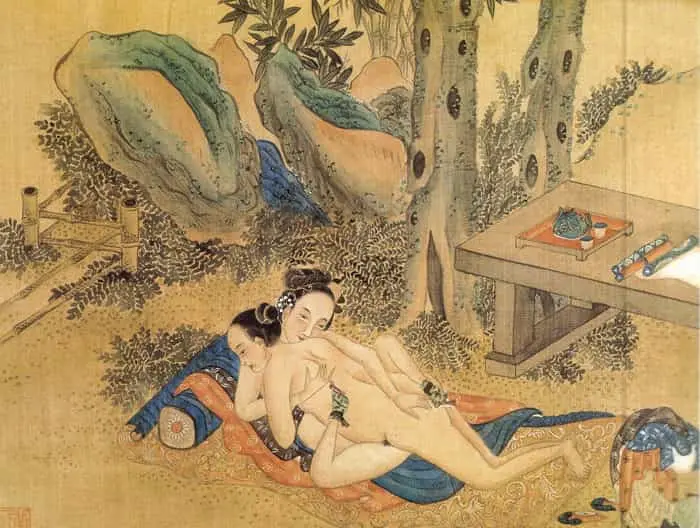
female private parts
Late Tang and Five Dynasties period,Flower CollectionThis aesthetic was pushed to its extreme. Wen Tingyun's "Exquisite dice inlaid with red beans, do you know the longing that penetrates to the bone?" On the surface, it describes an object, but in reality, it alludes to a woman's private parts. Wei Zhuang's "The woman by the hearth is like the moon, her fair wrists like frost and snow," when describing a tavern girl, always "inadvertently" focuses on her neck, wrists, and other erogenous zones. These poems created a kind of "voyeuristic aesthetic"—through fragmented descriptions of the body, they stimulate the reader's imagination to complete an erotic scene. As the French philosopher Barthes said, "The most alluring eroticism is never explicitly displayed, but rather makes the viewer a accomplice, jointly fulfilling the unspoken desire."
brothels
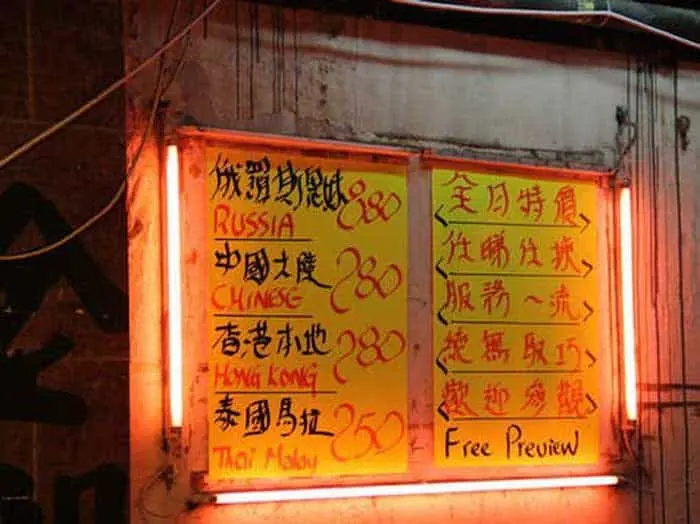
The Song Dynasty poet Liu Yong expanded erotic writing from the boudoir to the marketplace and brothels. His poem "Rainy Night Bell" vividly portrays the complex emotions between a prostitute and her patron, with the lines "Holding hands, gazing at each other with tearful eyes, speechless and choked with emotion." His more explicit work, "Day and Night Joy," with lines like "The bridal chamber is quiet after the drinking party, the curtains are drawn, embracing the fragrant quilt, hearts filled with joy," directly depicts scenes of sexual intercourse. Intriguingly, these works often appear in the form of "spring lamentations," ostensibly expressing a woman's longing for her husband who has gone far away, but in reality providing male readers with space for erotic imagination. This "using women to speak for men" writing strategy allows male desire to be expressed subtly through a female voice, constituting a unique phenomenon of "gender disguise" in Chinese erotic literature.
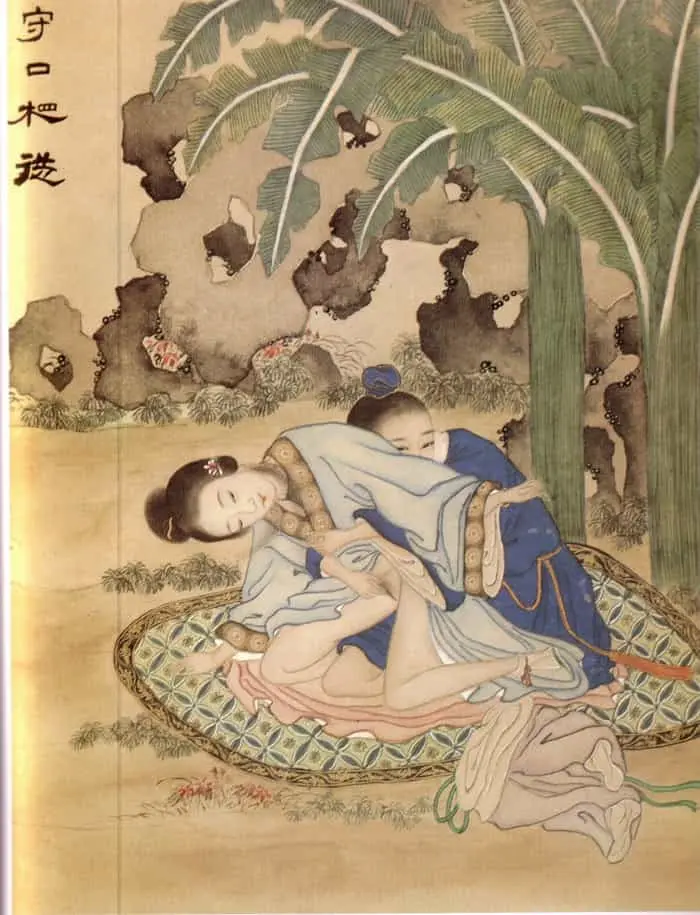
In the late Ming Dynasty, with the development of the commodity economy and the rise of hedonism, erotic poetry became more explicit. Tang Yin's "Song of Jealousy of Flowers" ("Last night the crabapple blossoms were first touched by rain, several delicate and charming flowers seemed to speak") uses flowers to symbolize female genitalia, boldly and explicitly. Feng Menglong's collection of folk songs further included a large number of folk erotic rhymes, such as "The girl is born smooth and slippery, she'll steal her lover when she meets him," completely shedding the restraint of literati poetry. This period also saw the emergence of "spring palace poems" specifically instructing on sexual matters, such as the "Ji Ji Zhen Jing" ("The True Classic of Completion") which describes "The woman embraces the man's waist, the man licks the woman's tongue, the penis moves up and down, attack and defense are measured," combining Taoist sexual techniques with poetic form to create a unique and practical form of erotic literature.
Sexual fetishes
Qing DynastyYuan Meiof"The Master did not speak of"and"The son remained silent.The book contains numerous erotic poems, including one about the "three-inch golden lotus" feet of a beautiful woman: "A glimpse of phoenix beaks on the hem of her skirt, and my soul is broken in Jiangnan." Through this fetishistic description of women's feet, it reflects the sexual fetish culture of the time. Intriguingly, these poems are often recorded under the guise of "abstaining from lust," but in reality, they are erotic descriptions disguised as moral condemnation, creating a paradoxical phenomenon of "forbidden yet widely circulated."
The allure of classical Chinese erotic poetry lies in its creation of a complete system of metaphors—such as the metaphor of "flowers in the backyard."poop eyesThe use of rain and clouds as metaphors for sexual intercourse, and fish and water as metaphors for harmonious sexual relations ("the joy of fish and water"), serves as a code that both satisfies the literati's need for erotic expression and maintains their moral image, allowing erotic literature to survive and develop under strict ethical norms. When contemporary readers interpret these poems, they are essentially engaging in a trans-temporal decryption game, reconstructing the author's hidden desires from elegant imagery.
Metaphor and Symbol
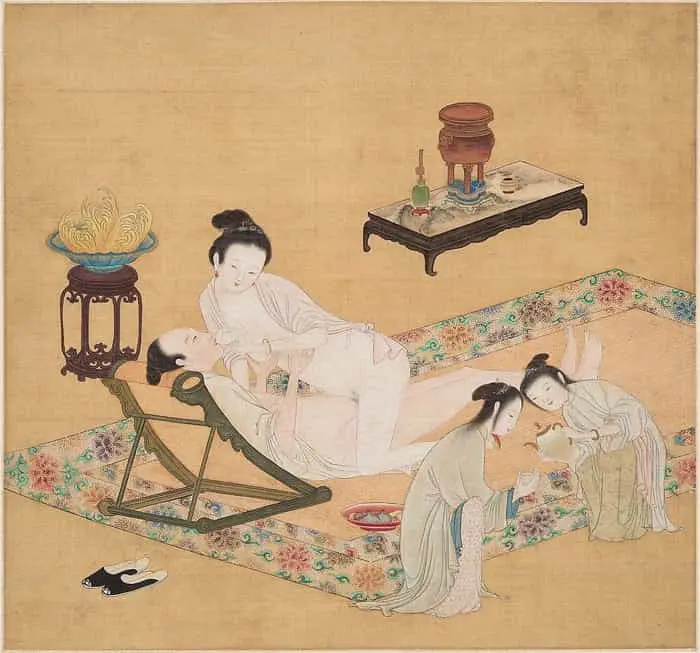
The most common techniques in Chinese erotic poetry are metaphor and symbolism. Poets often use natural scenery or everyday objects to allude to the human body or sexual acts. For example, Li Bai's poem...LongingIn the poem, the line "A beauty is like a flower beyond the clouds" uses "flower" as a metaphor for female beauty and "clouds" to suggest unattainable desire. This technique not only enhances the literary beauty of the poem but also seeks a balance between morality and aesthetics.
Imagery such as flowers, clouds, rain, and phoenixes frequently appears in erotic poetry. For example, "Clouds and Rain over Wushan"Originating from the Chu Ci, it was used to describe the pleasure between men and women, and later became a metaphor for male-female sexual intercourse."DickClassic metaphors of the time. In addition, items such as fans, silk curtains, and embroidered veils are often used to suggest the pleasures of the boudoir, and these images make the poems both subtle and full of imaginative space.
Straightforward description
Compared to metaphors, some erotic poems use explicit language to directly describe sexual scenes or physical beauty. This style is particularly common in Ming and Qing dynasty novels and folk poetry. For example, […].Jin Ping MeiA poem in the book says:Spring's beauty cannot be confined within the garden walls; a branch of red apricot blossoms peeks over the wall.The phrase, while seemingly descriptive, subtly alludes to female sexuality and infidelity. While this direct expression contradicts traditional morality, it truthfully reflects the complexity of human desires.
Cultural Reflection and Modern Significance
Rereading these lines of poetry, such as "Turning into spring mud to nourish the flowers" and "Now I bloom for you," we should not only see the erotic surface. From the *Classic of Poetry* to *Dream of the Red Chamber*, the writing about desire in Chinese literature actually constructs a hidden path of exploring human nature. In today's era, which is both overly exposed and excessively repressive, the frank yet subtle expression of classical erotic poetry may offer us a healthier narrative of desire—acknowledging the existence of desire without being enslaved by it; facing the needs of the body without forgetting spiritual elevation. This is precisely the most precious enlightenment that these ancient poems convey to modern people across time and space.
Conclusion
"Turning into spring mud for the back garden" is not only an epitome of erotic poetry, but also a symbol of love and desire in Chinese literature. These poems, with their obscure language, profound philosophical thought, and romantic imagery, transform the most private emotions of humanity into eternal art. Like fallen petals turning into spring mud, they nourish the back garden of literature, blossoming with a unique and captivating brilliance. In contemporary times, we should re-examine these works with an open mind, appreciating their literary beauty and experiencing the profound insights into humanity and life behind them.
Further reading: