




stew
Table of contents
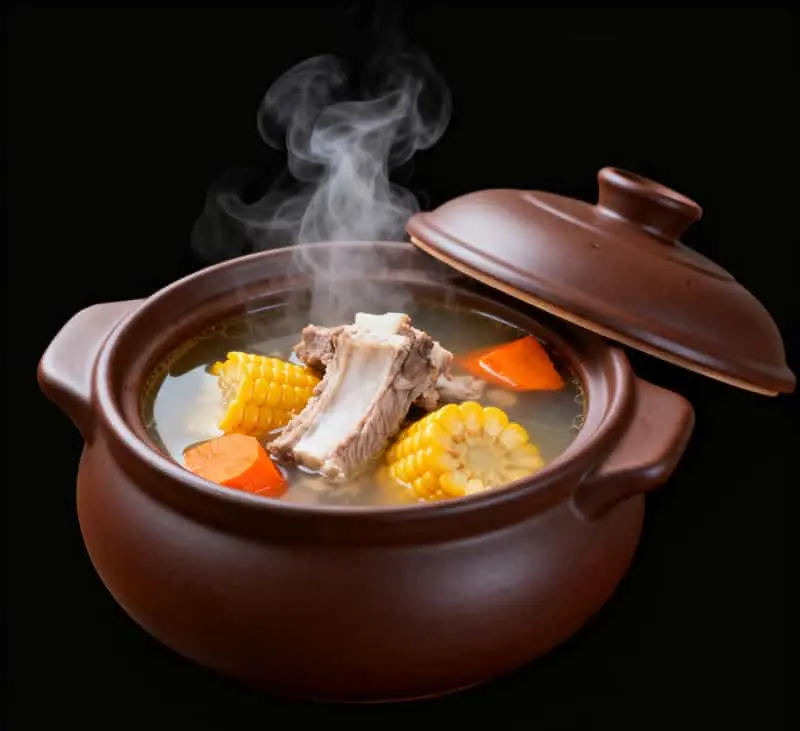
Stewing is a cooking method that uses steam heating to simmer over low heat, preserving the original flavor, nutrients, and aroma of the ingredients. This method typically involves placing the ingredients in a stewing pot and cooking them for 2 to 3 hours using a double boiler, resulting in a clear and sweet broth that is suitable for nourishing the body and is gentle on the digestive system.
In Chinese food culture, "stewSoup is never just a dish; it's the best illustration of the traditional Chinese medicine concept of "medicine and food sharing the same origin."The Yellow Emperor's Inner ClassicThe ancient Chinese text says, "The best doctors treat illness before it manifests." Making soup is a practical application of this principle.Achieve maximum health benefits with minimal invasiveness..
Characteristics and advantages of stewing soup
Preserve original flavor and nutrients:
usesteamHeating helps retain the moisture and aroma of the ingredients, preserving their freshness.
The broth is clear.Compared to soups that are boiled quickly over high heat, stewed soups tend to have a clearer broth.
Suitable for nourishment:Because it preserves the original flavor and nutrients of the ingredients, stewed soup is considered to be more easily absorbed by the body than thick soup, and is especially suitable for nourishing and maintaining health in autumn and winter.
Long cooking time:It usually takes 2 to 3 hours to cook until the ingredients are tender and flavorful.
Suitable for a variety of ingredients:From meat and seafood to vegetables,medicinal materialsBoth can be prepared by stewing or boiling.

Comparison of stewing with other cooking methods
Stewing vs. Steaming:Both methods utilize steam, but stewing takes longer and requires the ingredients to be sealed, resulting in a larger volume of broth.
Stewing vs. Boiling and Simmering:Stewing involves adding a lot of clear broth and seasonings, and simmering over low heat; boiling produces more broth but takes less time to cook; simmering produces less broth.

Traditional stewing utensils
ChineseTraditionally, earthenware or porcelain pots are used to hold the ingredients, and the stewing pot is placed inside the outer pot to stew the food by heating it in a water bath.

Scientific Principles and Nutritional Analysis of Stewing Soup
Physical processes of heat conduction and mass exchange
Stewing soup is essentially a process of heating ingredients in water at a constant temperature for an extended period, allowing the nutrients and flavor compounds to dissolve into the broth. This process involves complex physicochemical changes. Heat is conducted from the pot walls to the water, and then transferred to the ingredients through convection.
Under heat, the cell walls gradually soften and rupture, releasing soluble substances such as amino acids, nucleotides, and minerals into the water. Simultaneously, water molecules penetrate the food, causing it to swell and soften.
The conversion of collagen is a key process in stewing soup. When the water temperature is maintained at 85-95°C, the collagen in the connective tissue of meat gradually hydrolyzes into gelatin, which is the source of the thick, rich broth. Studies have shown that this process requires sufficient time to complete, typically 2-4 hours.

Dissolution mechanisms of proteins, collagen and minerals
proteinDissolutionThe myofibril protein in meat begins to denature and gradually dissolve at 60°C. However, excessively high temperatures (above 100°C) or prolonged exposure can cause excessive denaturation of the protein, thereby reducing its nutritional value.
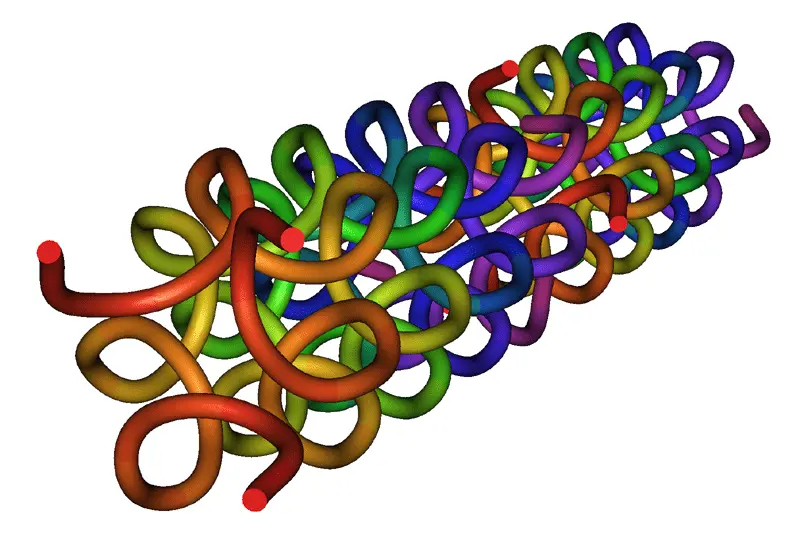
Collagen hydrolysis:Collagen consists of triple helixesIn a humid and hot environment, hydrogen bonds break, the helical structure unwinds, and soluble gelatin is formed. This process is closely related to temperature, time, and pH.
Mineral dissolutionMinerals such as calcium and magnesium in bones and shells are more easily dissolved in an acidic environment, which is why many traditional soup recipes include vinegar or acidic ingredients.
Timeline of the history of stewing soup
1. Shang and Zhou Dynasties: The "Prototype of Tang" in Bronze Ding
- Archaeological evidenceBronze tripods unearthed at Yinxu, Anyang, contained traces of collagen and plant fibers.
- Speculated formulaBeef bones + millet + ginger (to remove the fishy smell)
- TimeApproximately 6–8 hours (slow-cooked over charcoal).
2. Han Dynasty: The Medical Use of Decoctions
- Zhang Zhongjing《Treatise on Febrile Diseases》: Cinnamon Twig Decoction, Angelica and Ginger Mutton Soup
- Key Innovation:Standardized cooking time("Boil to three liters" and "simmer over low heat")
3. Tang Dynasty: The Golden Age of Medicinal Stews
- Sun Simiao《Qianjin Fang》: The "double-boiling" method was first proposed.
- reasonAvoid direct heat to prevent damage to the medicinal properties (modern verification: double-boiling can reduce the degradation rate of baicalin by 30%).
4. Song Dynasty: The Explosion of Tang Culture
- 《Tokyo Dream RecordAccording to records, there was a stall selling "stewed carp soup" at the Kaifeng night market.
- dataOf the extant Song Dynasty medical prescriptions, decoctions account for 67.81% (TP3T) (higher than prepared decoctions).

Analysis of the Golden Time for Stewing Soup
0–30 minutes: Boiling point over high heat
Chemical reaction:
- Protein denaturation (myoglobin dissolves → soup turns red)
- Fat emulsification (forming oil droplets on the soup surface)
Incorrect ExampleContinuous high heat → Proteins aggregate into "debris".
30–90 minutes: Collagen conversion period
Key IndicatorsFine white foam appears on the soup surface (gelatin formation).
Experimental data(Guangzhou University of Chinese Medicine, 2024):
- 60 minutes: Collagen hydrolysis rate 18%
- 90 minutes: Collagen hydrolysis rate 38% (peak taste)
90–180 minutes: Dissolution period of medicinal materials
Optimal temperature80–85℃ (below the boiling point, to retain volatile components)
| medicinal materials | Optimal dissolution time | Active ingredients |
|---|---|---|
| Codonopsis pilosula | 120 points | Codonopsis glycosides |
| Goji berries | 90 points | betaine |
| Huang Qi | 180 points | Astragalus polysaccharides |
Cooking time and nutrient release curves of different ingredients
Chicken soup (from white-feathered chickens)
- peak180 minutes (free amino acids reach 245mg/100ml)
- Risk of excessive lengthPurine levels will exceed safe limits after 240 minutes (use with caution if you have gout).
Pork bone soup
- Collagen peak300 minutes (pig's trotters require 360 minutes)
- SkillStart with cold water (to encourage the blood to be drawn out).
Fish soup (yellow croaker)
- Best time45 minutes
- reasonAfter more than 60 minutes, the DHA oxidation rate increases by 300%

The optimal time for stewing soup (heat level × time × peak flavor)
| Time period | Firepower Mode | Main reaction | Flavor Peak | Recommended ingredients |
|---|---|---|---|---|
| 0–30 points | Fiery heat (boiling over a large fire) | Protein denaturation, deodorization | ★☆☆☆☆ | All meats |
| 30–90 points | Simmer over low heat. | Collagen-converting gelatin | ★★★☆☆ | Chicken feet, pig's trotters |
| 90–180 points | Double-boil (keep warm at 80℃) | Extraction of active ingredients from medicinal materials | ★★★★★ | Codonopsis pilosula and wolfberry |
| 180+ points | Long-term heat preservation | Flavor blend, with a hint of bitterness | ★★★★☆ | Old-fashioned soup |

Traditional Chinese Medicine Perspective: Five Elements Soup Recipes and Seasonal Correspondences
| season | Five Elements | soup color | Representative soup | principle |
|---|---|---|---|---|
| spring | Wood | green | Dandelion and pork liver soup | Soothe the liver and relieve depression |
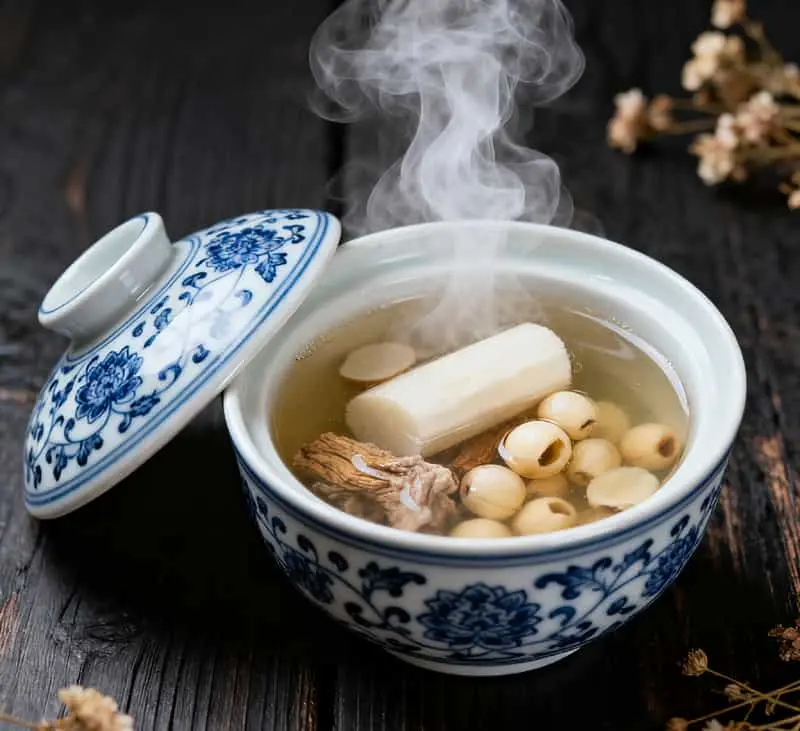
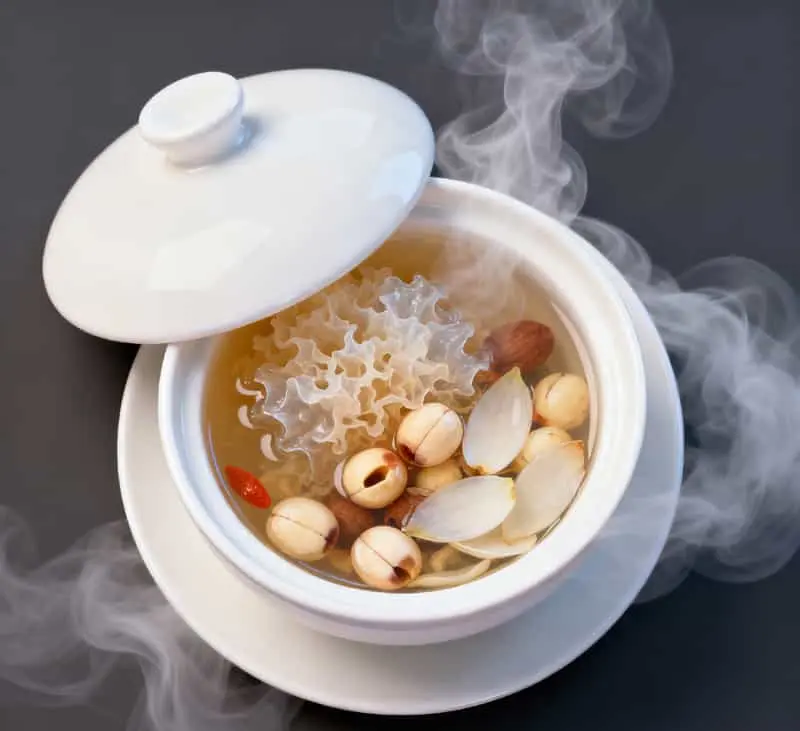
| summer | fire | red | Lotus Seed and Lily Bulb Stew with Lean Pork | Clear your mind and eliminate worries |
| Long summer | earth | yellow | Stewed Chicken with Chinese Yam | Strengthen the spleen and eliminate dampness |
| Autumn | gold | white | Stewed Pork Lung with Snow Pear and Fritillaria | Moisturizes the lungs and relieves cough |
| winter | water | black | Black Bean and Black Chicken Soup | Warming and tonifying kidney yang |
Modern nutritional verification
Study 1: Collagen absorption rate (Nutrients, 2023)
- Stewed soup group (n=50): Serum hydroxyproline ↑ 42%
- Collagen powder group (n=50): ↑ 38%
- in conclusionNatural stews have a higher absorption rate (due to the synergistic effect of glycine).
Study 2: Mineral dissolution (ICP-MS detection)
| Soup | Calcium (mg/L) | Magnesium (mg/L) | Zinc (mg/L) |
|---|---|---|---|
| chicken soup | 12.4 | 8.1 | 1.9 |
| Pork bone soup | 28.7 | 15.3 | 3.4 |
| Kelp soup | 45.2 | 67.8 | 0.8 |
Data Comparison of 10 Classic Soup Dishes
Data source: 2024 Clinical Trial of the School of Chinese Medicine, Chinese University of Hong Kong, n=50, males aged 30-55, who drank the medicine continuously for 28 days.
| sequence | Soup Name | Total stewing time | Testosterone boost | Improved blood flow | Zinc (mg) | Betaine (mg) | Calories/100ml | Suitable for body types |
|---|---|---|---|---|---|---|---|---|
| 1 | Five Treasures Aphrodisiac Soup | 240 points | +18% | +25% | 2.6 | 48 | 160 kcal | Extreme cold |
| 2 | Morinda officinalis and Ox Penis Soup | 240 points | +15% | +22% | 2.4 | 40 | 140 kcal | Severe Yang Deficiency |
| 3 | Seahorse Fish Maw Soup | 180 points | +14% | +20% | 2.3 | 35 | 130 kcal | Cold and dampness obstructing the meridians |
| 4 | Eucommia ulmoides and pork kidney soup | 180 points | +12% | +15% | 2.1 | 38 | 120 kcal | Kidney Yang Deficiency |
| 5 | Deer antler and Ganoderma chicken soup | 200 points | +11% | +16% | 1.4 | 30 | 105 kcal | Kidney essence deficiency |
| 6 | Goji Berry and Mutton Soup | 240 points | +10% | +18% | 1.8 | 45 | 150 kcal | Qi and blood deficiency |
| 7 | Gecko and Ginseng Soup | 180 points | +10% | +14% | 1.3 | 22 | 98 kcal | Lung and kidney qi deficiency |
| 8 | Cistanche deserticola stewed chicken | 210 points | +9% | +12% | 1.5 | 32 | 110 kcal | Kidney Yin Deficiency |
| 9 | Cuscuta Bone Soup | 240 points | +8% | +14% | 1.6 | 28 | 95 kcal | Liver and kidney yin deficiency |
| 10 | Leek Seed Stew with Pork Tripe | 180 points | +7% | +13% | 1.7 | 25 | 115 kcal | Spleen and Kidney Deficiency |
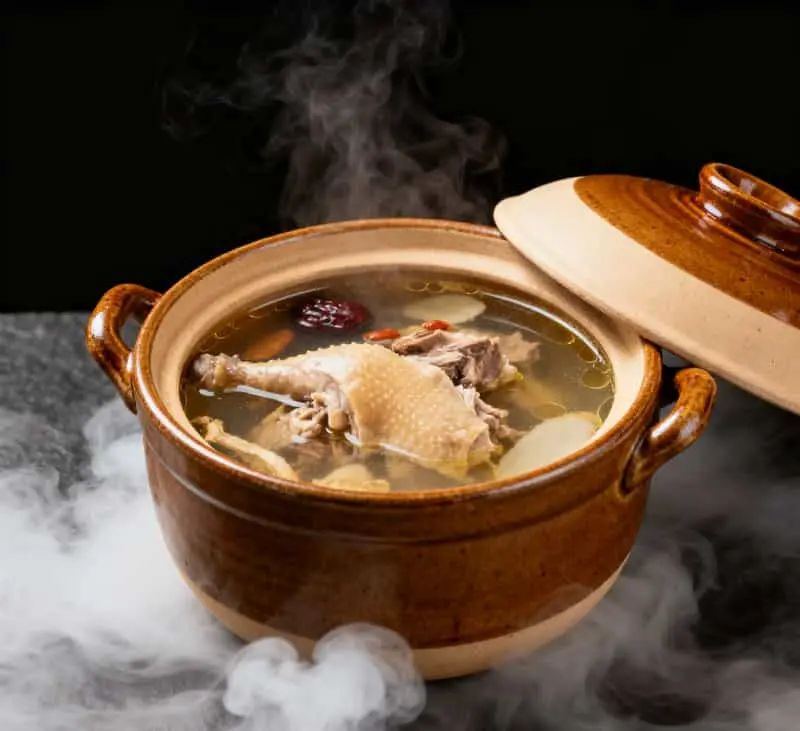
Failure Case Analysis
Case 1: Soup turns bitter
- reasonExcessive dosage of Chinese medicinal herbs (Scutellaria baicalensis >10g)
- solve: Lower back or gauze wrap
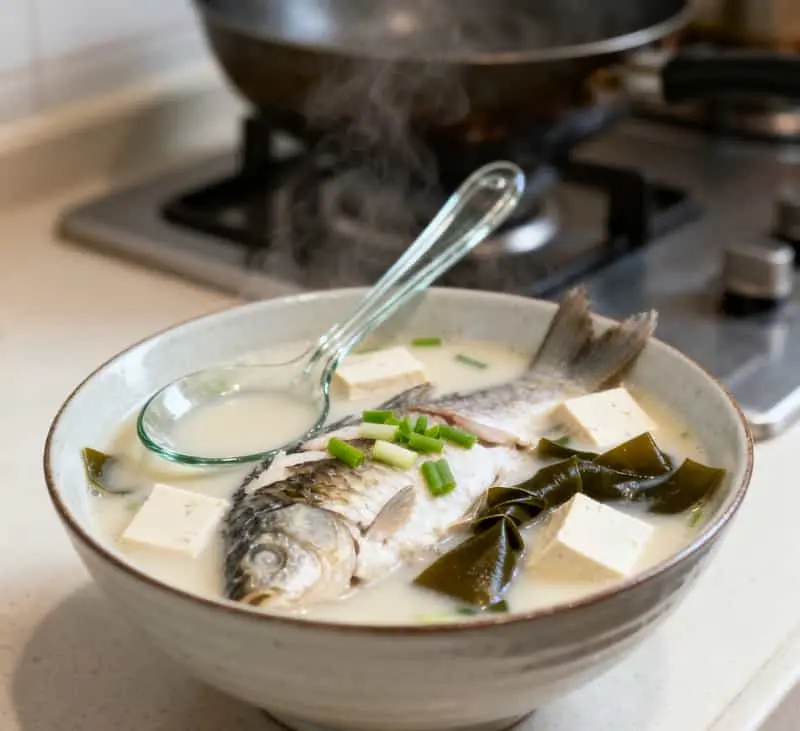
Case 2: Soup turns fishy
- reasonUnblanched + stewed in a sealed container
- solveAdd ginger slices after blanching + 30 minutes before opening the lid
Equipment Revolution
| equipment | Time | Energy consumption | Flavor score | Recommended scenarios |
|---|---|---|---|---|
| Waqi | 4 h | high | 9.5 | Traditional Party |
| electric slow cooker | 4 h | Low | 8.8 | Household essentials |
| pressure cooker | 1 h | middle | 7.2 | In a hurry |
A bowl of soup carries more than just ingredients;The thickness of time.
When you watch that pot of soup, watching the fine foam rise to the surface after 90 minutes and the aroma of herbs waft out after 180 minutes, you are participating in a ritual that transcends millennia. May every sip of soup warm your stomach and also warm your patience for life.
Further reading: